Showing posts with label western australia. Show all posts

Saturday, August 13, 2011

Oldies But Goodies


This week's PhotoHunt theme is one.

If you are wondering how this picture represents one, your have to go beyond counting the thrombolites, and look at the cell structure of these pre-historic living rocks. Scientist believe that the one celled organism is the earliest form of life on earth, and they date back about 3500 million years.  These relics are mostly extinct and exist only as fossils, but living examples can still be found growing a handful of places in the world. These oldies were photographed at Lake Clifton, 100km south of Perth.

Saturday, July 30, 2011

Come Together...


This week's PhotoHunter theme is together.

Normally I am separated from my mother by thousands of kilometers. Fortunately, this past May she made the long journey from Oregon to Western Australia. Here is a picture of us together at the Pinnacles. 

Monday, July 25, 2011

A Lesson Learned

The sun was already making its descent when we arrived at Avon National Park. Even though it was the middle of winter school holidays, we had taken our time arriving at the park because we were hoping that the sun would dry up some of the puddles from the previous night's rains. We had been told that the park was visited by few and that camping wouldn't be an issue. But still, we were anxious about finding a suitable spot. Fortunately, the park boasts 5 campgrounds, so we figured we would find something. 
The dirt roads were still a bit wet, and we were glad that we had rented a 4wd.  Slowly we made our way  into the park, and it wasn't long before we came across the first campground. Unfortunately, the place was chock-full of caravans so we carried on. We decided to skip the turn-off to the second campground and headed for the one at the top of the hill. When we crested the bald hill we were greeted with plenty of sunlight. The setting looked idyllic, but upon closer inspection of the established neighbors we decided it was best to continue our search. We headed back to the campground we had passed up. The road slowly meandered towards the valley and I doubted that we would a sunny spot in the hallows. Fortunately, the track didn't reach the canyon floor and the campground was on a sunny plateau. There were only two other tents in the area, but there was no one around. There was an isolated area off to the side, so we staked our claim. 
Rather then setting up camp we decided to hit the trail. A steep single track continued from where the road ended and we were quickly taken down to the canyon bottom. The recent rains had turned to the valley into lush meadow lands. Even though our journey had been short, I felt as though I had been transported thousands of miles away to the center of Ireland--with its 40 shades of green. I wanted to continue exploring the valley, but unfortunately the marked trail ended at a waterfall. We did see several secondary trails, probably made by roo's and feral goats, but the terrain was just too rough so we decided to return to camp.


Our neighbors had not yet returned, and no one new had joined us so we had the place to ourselves. We quickly set up camp and sat out to enjoy the late afternoon sun. It wasn't long before the sun disappeared. Even though it was the middle of winter the temperature was mild enough for us to sit through several games of cards, enjoy an alfresco meal, and watch the moon begin its ascent. 
By 7:30 we were amazed that our neighbors had not yet returned. One of the campsites had a car next to it, and the other campsite consisted of a single person swag with nothing else. We began to question if the campers were a group and out and about in a second car, or if the campers were out on the trail. 
By 8:00 we decided it was time to investigate. A quick walk through the campsite assured us that no one was asleep in the tents. A meal had been cooked and everything had been left neat and tidy. It appeared that the two campsites were a group. We still had no idea if there was a second car around, or if they were out walking. We worried that since a headlight was left outside the tent, if they were walking at least one person didn't have a light. I couldn't help but be concerned, but without knowing if there was a second car all we could do was wait until morning. So we tried to put our neighbors out of mind and enjoy the rest of the evening. 
Fortunately at some point in the night they made their return by car (we slept right through their entrance). The experience has made us realize just how important it is to leave hiking details on the car windscreen if nothing else as a courtesy to your neighbors. A lesson you think we would have learned on this adventure.

Saturday, June 4, 2011

I'll Skip The Bubble Bath


This week's PhotoHunt theme is dirty.

With all the mining in Western Australia you got to wonder what is being dumped into this river making it dirty?

Wednesday, June 1, 2011

Where There Is Smoke There Is Fire

The heat of summer lingered and continued to hold us in its grips even though the days were growing considerably shorter. We decided to head a couple of hours south to try and find some relief from the unseasonable heat. We had picked our final destination, Wellington National Park, not because of its several waterholes but for its magnificent eucalyptus forests and several hiking trails. 
We were on our final approach to the park when we passed a large smoke plume. The burning fire was far away and wouldn't impact us, but as I watched the billowing black smoke I couldn't help but feel sad since I knew the drought conditions would make it hard to control the fire.
At the park entrance we turned off the bitumen onto a red iron track. Slowly, we made our way deep into the forest, and we were soon surrounded by towering mahogany colored trees. At the campground, when we exited the car, a feeling of uneasiness came over me. I quickly realized\ we were surrounded by red. It was not just the ground and trees, but the air had taken on a red tinge--the result of the sun filtering through the haze created by the distant fire.
We were so anxious to hit the trail that we couldn't be bothered with setting up camp. Instead we set out a table and some chairs to mark our territory, and hit the trail. 
The single track followed a crystal clear creek, and even though the water looked inviting we knew we had to carry on, especially if we were to complete the 20 kilometer loop before dusk.  At least the temperatures deep in the river valley were cool. Unfortunately, it wasn't long before the track left the valley and headed up a steep escarpment. As we zigzagged our way up the hill the air became warmer and thicker. When we reached the top of the hill our view was hindered by the smoke that was rolling in over the valley. If we hadn't known where the actual fire was at this point we might have become concerned, but we knew it was far enough away that we need not worry. At least that was what we thought until we were an hour further down the rim. 
The eerie red glow that had accompanied us earlier that morning had been replaced by a shroud of grey. We stopped to scan the horizon for an indication that the fire was moving our way. There were no plumes or flames to be seen, but the thick warm air had been replaced with a searing hot breeze. We began to question if we had made a mistake and if the fire was closer than we thought or, even worse, had a second bushfire started in our vicinity. We tried to remain calm and kept trying to convince ourselves that if the fire were close we would see flames, and that it was just the wind that was carrying the heat and smoke. At that point we were less than half-way into the loop and it was time for us to decide whether to turn back towards our car or carry on. The decision was difficult, but we figured that, by continuing, within 30 minutes we would be at the dam and our return trip would take us along the river which would become useful if there was indeed a fire traveling our way. As we continued on I couldn't help but beat myself up mentally for not being bushfire prepared--we didn't have all cotton clothes and hadn't left our hiking plans with anyone--how could we have been so careless? This experience would certainly go down as a lesson learned in the outback.   
Our fast steps quickly brought us to the dam and even thought it contained very little water we couldn't help but feel relief.  As we dropped back down into the cool air of the river valley we knew our fear turned from fire to arriving back at camp before dark. 

Saturday, January 15, 2011

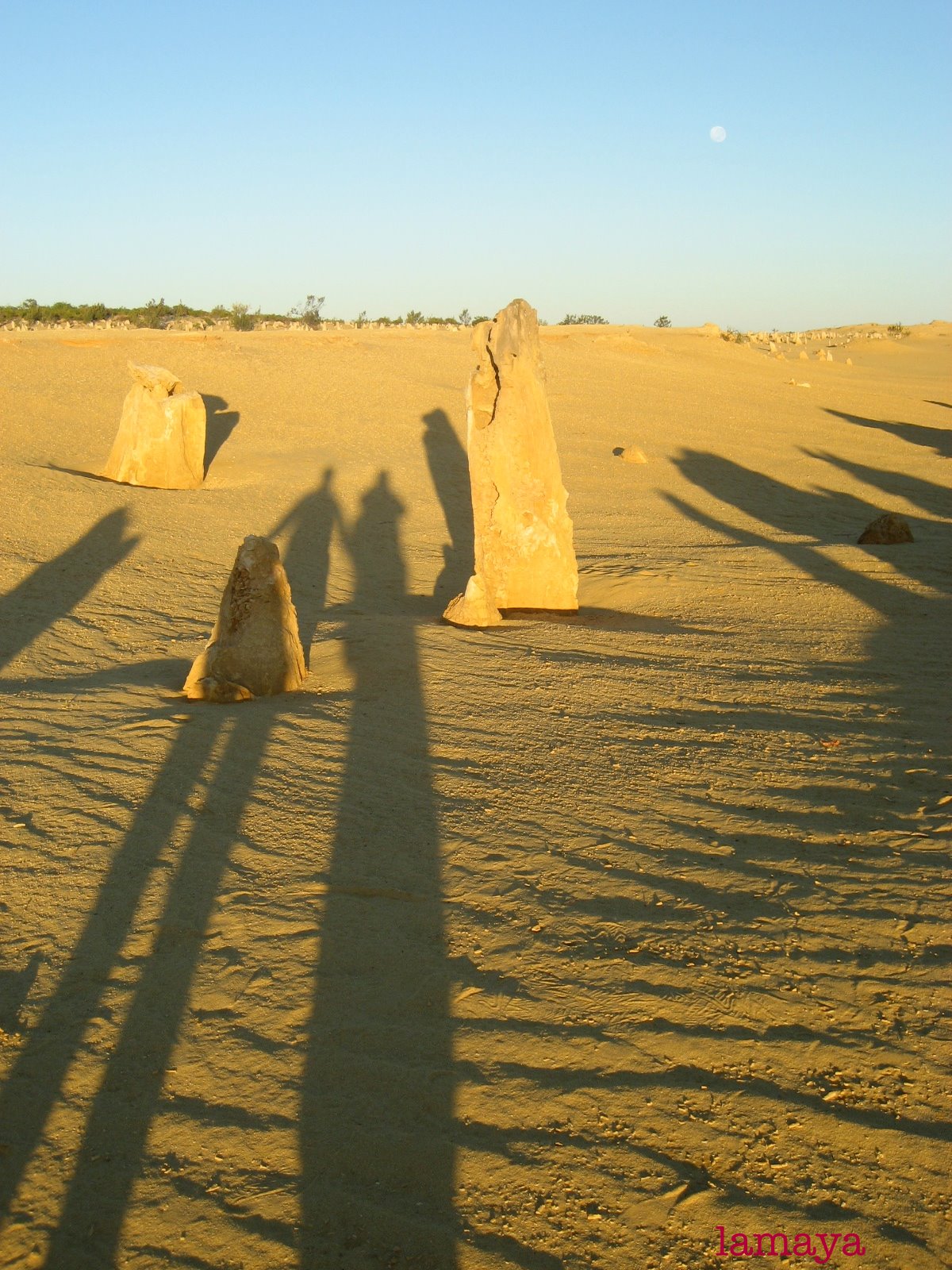
Casting A long Shadow


This week's PhotoHunt theme is shadow.

This photo was taken when visiting Pinnacles Desert at sunrise. You can read all about our 1st road trip in Western Australia here. I am also happy to announce that we will soon be calling Western Australia home and we will be moving to Perth at the end of the month. 

Tuesday, November 30, 2010

Colorful Bliss

Last year during the Adelaide Fringe Festival I heard some people talk about the amazing experience  they had visiting Amococo. Unfortunately, I never got my act together enough to visit what was being called a strange and sensual world. However, it wasn't until I saw the surreal photos from the inside of the monumental sculpture that I realized I had missed something spectacular.
So a couple of weeks ago when I saw a similar structure sitting in the middle of  Perth, I knew I was being offered a second chance at an art experience that promised to combine light, sound and architectural form.
The plastic sculpture, Levity III, which stood in the center of Forest Plaza was designed by Alan Parkinson. From the outside it resembled an inflatable tent, but it is one of several luminaria--"a dazzling maze of winding paths and soaring domes." Shoeless visitors are invited to move though the inflated plastic tunnels and chambers as they experience saturated and subtle hues not found in everyday life. 


My free visit to Levity III occurred on a hot spring afternoon. The temperatures inside the structure were warm, but for me this enhanced the experience, not only because of the additional stimulation of the senses, but also because it helped keep the crowds away. For nearly an hour I explored my environment in a light that appeared liquid in nature. It constantly blended, radiated, resonated, and transformed my surroundings. The calming effect of the structure was unlike anything I have experienced and I eventually had to pull myself away or risk severe dehydration.
Outside in the harsh sunlight I reflected on how while my friends and family--thousands of miles across the sea--were preparing to celebrate Thanksgiving, I was thankful that I had a second chance for such an amazing experience.
Levity III left Perth this weekend, but the tour will continue in 2011, starting with Sydney. So, if you get a chance, be sure to check out an amazing piece of interactive art.

Posted by Picasa

Sunday, September 12, 2010

A Theft Of Aboriginal Land

One of Australia's most pristine coastal areas is currently the center of controversy. The land--Walmandany--is located north of Broome in Western Australia and it is currently under control by its Traditional Owners the Jabirrjabirr people. Unfortunately, Walmandany (James Price Point) is a preferred site for a liquefield natural gas processing precinct. Western Australian Premier, Colin Barnett, is expected to start proceedings to acquire land later this week. This move is supported by the WA Government and the Kimberley Land Council on the grounds that development will be good for everyone and that jobs will be brought to the area. However, the reality is that should the proposal proceed it will represent another theft of aboriginal land.
To learn more about this invasion and become involve read Another Invasion by Mick Dodson.

Friday, September 3, 2010

Unexpected Discovery


Our first trip to Dryandra was not completely fruitless. On the final leg of our hike, just as we were about to leave the forest for the car-park I spied this "little" guy. I think the primarily nocturnal reptile was trying to escape the heat.  
The non-venomous Carpet Python is named for their beautiful markings. Their color and pattern vary greatly. Eastern populations are pale or dark brown to olive-green, with irregular dark-edged cream to pale yellowish blotches. Other populations can be grey or reddish with darker blotches.
The medium-sized python can grow up to 3.6 meters (12 feet) in length and with up to 15 kilograms.  The average adult measures 2.4 meters (8 feet) long.  
Their diet consists of a variety of birds, bats lizards, and small mammals. They kill their prey by constricting it until it suffocates.  They are often the largest predator in their ecological community. 
You can find carpet pythons in heavily timbered areas from Western Australia through the top Northern Territory, though to the eastern states. They like to hide among leaf litter in tree hollows, logs and rocky crevices.  
If you find yourself in Dryandra in search of numbats you may want to take care because even though the Carpet Python is not venomous they can give a painful bite.    

Wednesday, September 1, 2010

Hunting For Numbats

Oh! How I wanted to go to Monkey Mia, but our previous trip to Western Australia had taught me that 700+ km was just too far. So I hit the tourist office and tried to find something a little closer. As I perused the pamphlets of day excursions, one donning a striped chipmunk-like critter caught my eye. I read through the brochure I could barely contain my excitement.  Less than 2 hours from Perth was Dryandra Woodland--home of the numbat. I made up my mind and the following Sunday we were going on a numbat hunt.
As we sat on the portico of a local cafe eating a big brekkie we knew the day was gonna be a hottie.  The sun was still low on the horizon, but the temperature in the shade was already becoming unbearable. But I wasn't going to let a little heat deter me; I was determined to see a numbat.
We found relief from the heat in the air-conditioned car as we followed the Great Southern Highway south.  We slowly made our way out of one of the world's most isolated cities and began to cross the wheat belt.  For miles on end we passed through the fields of heavy-headed, golden, sun-dried wheat stalks. As I looked out the window at the horizon it was hard to believe that somewhere in the distance we would find a magnificent wandoo forest--the remnant of a time before farming. Fortunately, the brochure didn't lie and about 1.5 hours outside of Perth a forest appeared on the horizon.  
The final approach to the trail we had planned to hike, was on an unsealed road.  As we turned off the air-con and rolled down the windows we were greeted with a blast of hot air.  It was well into the upper 30's.  We weren't too worried since the trail we were going to walk was short--only 5.5 km--and we had our hats, sunnies, sunblock and plenty of water.  

As we hit the trail I was taken back by the beauty that surrounded me. The variety and contrast of the trees was extraordinary. We passed through groves of powderbarks (with their powder skin cover), rock sheoak (with their dense weeping foliage), salmon gum (with their creamy orange trunks), and banksia (with their twisted and gnarled trunks). The meandering trail slowly climbed the laterite breakaways--rocky, flat-topped hills. Eventually, we re-entered the open woodland. Here amongst the hollow fallen trees I searched for the small marsupial found only in this part of the world. Unfortunately, probably due to the heat, this normally diurnal animal was nowhere to be found.  I couldn't help but feel disappointed as the circular trail returned us to our car. However, with the national park's proximity to Perth I new that we would one day return.

Monday, August 30, 2010

Bang For The Buck

We had hoped to make the 700 kilometers round trip journey to Wave Rock  in a day, but 97 east of Perth we decided to call it quits.  The map on my lap didn't inform me that the town was settled in 1831 and is the oldest inland town in Western Australia, or that it was an extremely popular place for a weekend get-away destination. We chose it for a stop-over because we were tired and the sun was setting.

As we drove down the main road we were greeted by some beautifully restored heritage buildings and several had been converted into charming sleeping options with character. Unfortunately, they were all booked. The only place with availability was Kookaburra Dream Travellers Overnighter, the valley's only backpacker hostel.  It had been years since we last stayed at a hostel, and even though we were not looking forward to returning to our days of budget traveling, we also realize it would be impossible for us to carry on. The sign in front of the building informed us that there was space available but that we needed to call the provided number for more information.  To our relief not only was there a bed available, but there was a private room.  The only downside was we would be sharing the bathroom-which turned out to be no drama since it was kept fastidiously clean.


Overall the Kookaburra turned out to be a travelers dream come true.  The building was centrally located and within walking distance of all the local attractions.  Our private room was separated from the rest of the house, and we had our own secluded garden.  The amenities--self-service kitchen (fresh breakfast supplies provided), lounge with fireplace, bathrooms, gardens and outdoor barbie area--were all spacious and meticulous.  The staff were courteous and helpful.So next time you are in the Avon Valley and are looking for budget accommodations that provide more than just a bed to sleep in call in at the Kookaburra.

Sunday, August 29, 2010

BaaaaaArt

"Big Bart" is located three hours from Perth at the main entrance to Wagin, Western Australia.  The 4 ton ram was built from steel and covered with fiberglass.  The giant is 9 times the size of a live ram and measures 7 meters high and 13 meters long. The statue stands as a monument to celebrate the town's prosperity and reliance on the wool industry.

Saturday, August 21, 2010

Count Von Count


This week's PhotoHunt theme is numerical.

The numerical value of this photo is not the number of buildings on the lefthand border. Instead, it is the length of the pier that extends behind them. The jetty is located in Busselton, Western Australia. It measures 1841 meters and is the longest wooden pier in the southern hemisphere. It was built 140 years ago because the shallow waters of the Geographe Bay didn't allow cargo ships to enter the area. The original jetty only measured 176 meters in length. However, due to accumulation of drifting sand the jetty was continually extended until it reached its current length in the 1960s. In 1971 the jetty was visited by its last commercial ship and it ceased being a working jetty. Today it is used exclusively for tourism and recreation.

Tuesday, August 17, 2010

He May Be Hot, But He Doesn't Breath Fire

When surfing Wave Rock it is important to keep your eyes open because more than likely you will see an ornate dragon.  However, no need to worry that a fire-breathing creature will snatch you up while you are surfing since the striped lizards are about the size of you foot.  This species of lizard belongs to the Agamidae family, and can only be found in Western Australia. They are a common sight on the many granite outcrops of the southern part of the state.  When out in the open, basking on the warm rocks, they often display a head bobbing characteristic.  When the head bobbing is accompanied by a push-up like movement, the dragon is engaging in a mating ritual. The movement allows them to display their chest and throat region thereby transmitting information about attractiveness and availability to potential mates. 

Monday, August 16, 2010

Let's Go Surfing Now

You would think we would have reflected on our previous driving experience as we made the decision of where to visit on our second trip to Perth. However, the idea of driving 700 kilometers in a day didn't stop me from wanting to visit Wave Rock. I was still in the "we may never have another chance to visit" mode. I am not sure how, but I eventually got Mark to agree to make the long trip. It was probably because I threatened to do it on my own during the week on a tour, and he didn't want to miss out on something great. However, he continued to feel that traveling such large distance, so I could take a  photo of me surfing in the middle of nowhere, was a bit idiotic.
We arrived in Perth early in the morning. The sun was still low on the horizon but we could tell it was going to be a warm day in March. We drove 130 kilometers to our first stop. I just had to call in at Meckering since there was a "big" photo op I couldn't pass up. The draw in this small town is a giant 35mm camera--home to a museum dedicated to photography. Original we had planned to stop for a quick Big Thing photo and continue on our journey, but we decided to go in and check out the displays. The museum's collection was pretty impressive, with over 1,000 items including cameras, projectors, enlargers, processing equipment, slides and movie cameras.


After this stop, we were less than half-way to our destination, so we continued on.  At just after 1:00 p.m. we pulled into Hyden, the small town near Wave Rock. We decided to grab a bite to eat before heading out to go surfing, but the only eating option was the petrol shop.  It looked like a Chiko Roll and Pie would have to do---mmmm the savory snacks of Australian road trips. With full bellies we were prepared to hit the surf. I was a bit worried that the wave would not live up to my expectations.  However, as we stood at the base of the 15 meter high and 110 meter long natural wall I knew the drive was worth it.
There are several opinions on what caused the unique rounding of the face of the granite cliff. Some believe it occurred millions of  years ago by subsurface chemical weathering. Others say wind and water erosion have undercut the softer rock beneath the upper edge and have left a round overhang giving the rock formation am impressive wave-like shape. Whatever the cause it has become one of Australia's most famous landforms.


You can find me surfing the wave in this post

Wave rock became a popular tourist attraction in 1967 when it made a cameo in National Geographic Magazine. Previously, the unusual formation was virtually unknown outside of the local farming community. Prior to the Wave's rise to stardom the inselberg had a much more utilitarian role. In 1951 a retaining wall was constructed long the edge of the rock to direct rainwater into a storage dam. This dam continues to supply the local community of Hyden with water.
In addition to "surfing" the rock face and visiting the dam, we decided to take some time to explore a couple of the walking trails around Hyden Rock. The panoramic view from the summit of the rock was worth the effort.  We also swung by the landform called the Hippo's Yawn.  As we stood in front of the outcrop, trying to envision the large mammal's mouth, I couldn't help but wonder if perhaps someone had accidentally added an apostrophe instead of a comma and if the name should have read  Hippos, yawn.
Unfortunately, we were fighting time and, with over 300 kilometers in front of us we had to hit the road.


Wednesday, August 11, 2010

The Maritime Museum In Western Australia

Australia is a country with strong ties to the ocean, so it only fitting that Western Australia has a world class Maritime Museum.  The museum is located a short 30 minute train ride from Perth's CBD, perched on the shore of the Indian Ocean in Frematle.  
Visitors are invited to explore the role the ocean has played not only in the development of this young country, and its current role in its life today.
The museum beautifully showcases Western Australia's strong fishing industry which is traced back to the use of Aboriginal fish traps. Stories from the past and present are included to demonstrate the challenges and successes of the local fishing communities.
A long term exhibit demonstrates the important role trade has played for thousands of years, ranging from the exchange of simple products and ideas by the people living on the borders of the Indian Ocean to the more current globalized trading, where thousands of cargoes are brought into the Australia through maritime trade.
There is a gallery that focuses on the stories of bravery, war, peace, sacrifice, weapons and naval defense.  Here, visitors learn the strategic importance of Fremantle.
Of course, a Maritime museum would not be complete without a display of watercraft, and guests are treated to an array of vessels.  Needless to say the pride and joy is the Australia II, the racing yacht that won the America's Cup in 1983.  

Victoria Quay, Fremantle
Open daily: from 9.30-5.00, excluding Wednesdays.
Closed Christmas Day, Boxing Day, New Years Day, Good Friday, Easter Monday and Anzac Day.
Public information phone number  +61 [0]8 9431 8444

Monday, August 9, 2010

Tasty Green

One of the biggest problems that we have faced in WA, other than distance, has been eating out.  Not only has food been extremely expensive, but for the most part the quality has been a disappointment.  In fact, I have probably been served some of my worst meals here in Perth.  In trendy Subiaco, I ordered a warm mushroom salad and was brought a bowl of mushrooms swimming in a sea of sherry without a green to be seen--can you say gag.  At another historic eatery, famed for its meat, I was served a gourmet burger that took me back to the hamburgers served at my elementary school cafeteria.  I am sorry, just because the the beef is Wagyu doesn't mean you can charge AU$25 for a compressed patty that resembles a char-burned shoe sole.
After our first couple of visits to the city and trying a variety of eating venues, we had to turn to pub food.  At least we knew what to expect, even if it was over priced.  Then on our visit last January, someone suggested that we try one of Perth's newest eateries, The Greenhouse.  I was a bit skeptical as I listened to the rave reviews about the amazing, funky fresh, organic food--but we decided to give it a try.
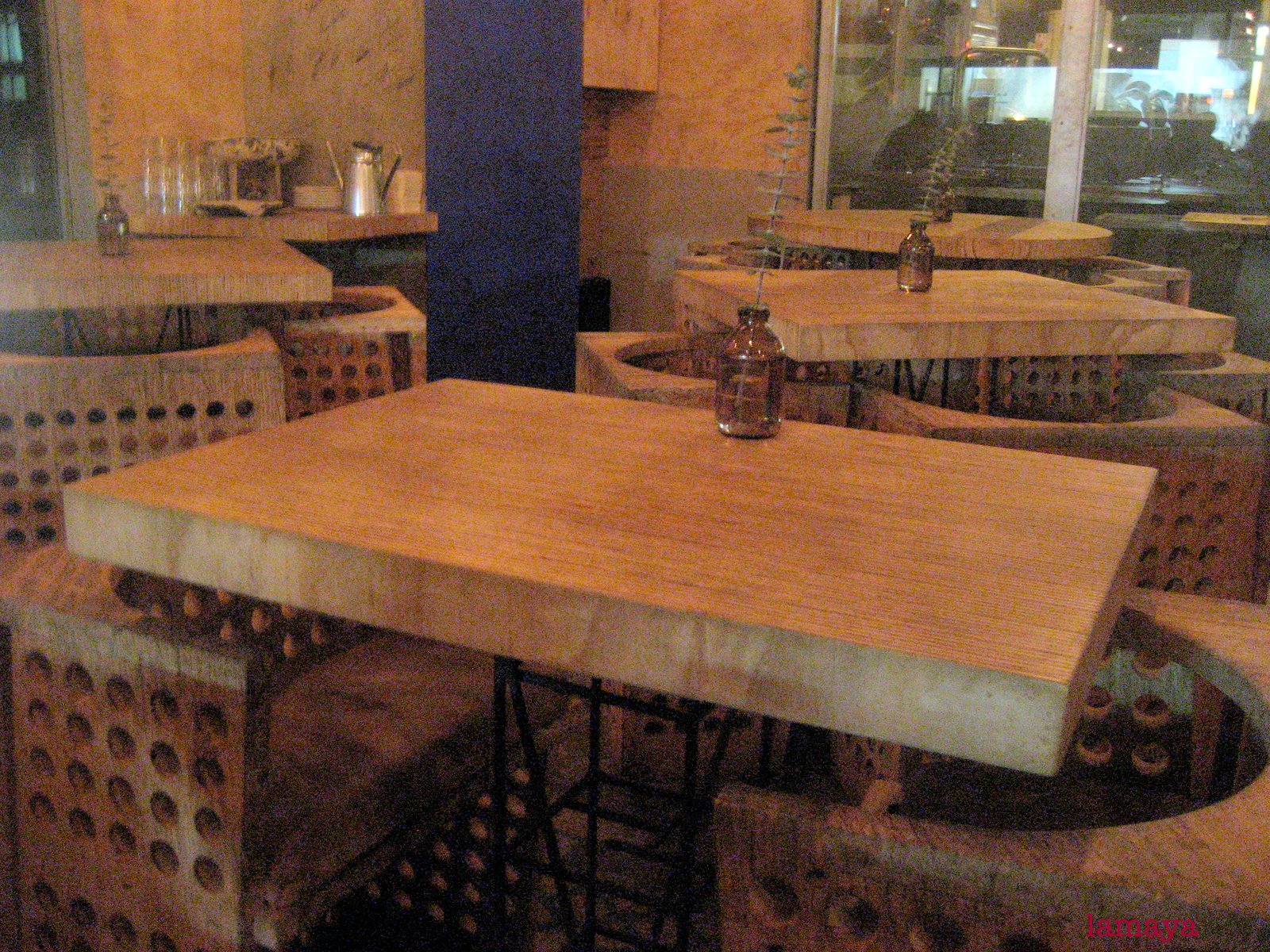
When we arrived at the Green House, I knew we weren't in your normal run of the mill type of place.  The owner's strong eco focus can be seen the moment you pass through the door.  The space and furnishings have been constructed with recycled materials.  However, even though I was impressed by the use of recycled and recyclable materials--I was there to eat.

Service was prompt and friendly.  The menu, which featured small plates, was simple but varied.  We decided to try four plates: lamb kofta, duck rillette, fried cauliflower, and  piquillo croquetas.  All I can say is that when the food arrived it exceeded our expectations.  It was obvious that the Chef knows his trade.  He took simple, quality ingredients and made some excellent non-pretentious plates that looked beautiful and tasted great.  At last we had found a restaurant in Perth that meet both our needs and tastes.

Sunday, August 8, 2010

A Birds Eye View

This past summer, January in Oz, we once again found ourselves amongst the giant karri trees.  The summer heat in Perth was full on so we decided to try and escape it by making the long drive down the moss covered forrest.  Of course, like with our previous visit, we didn't have enough time but, once again, we were enchanted with the area.


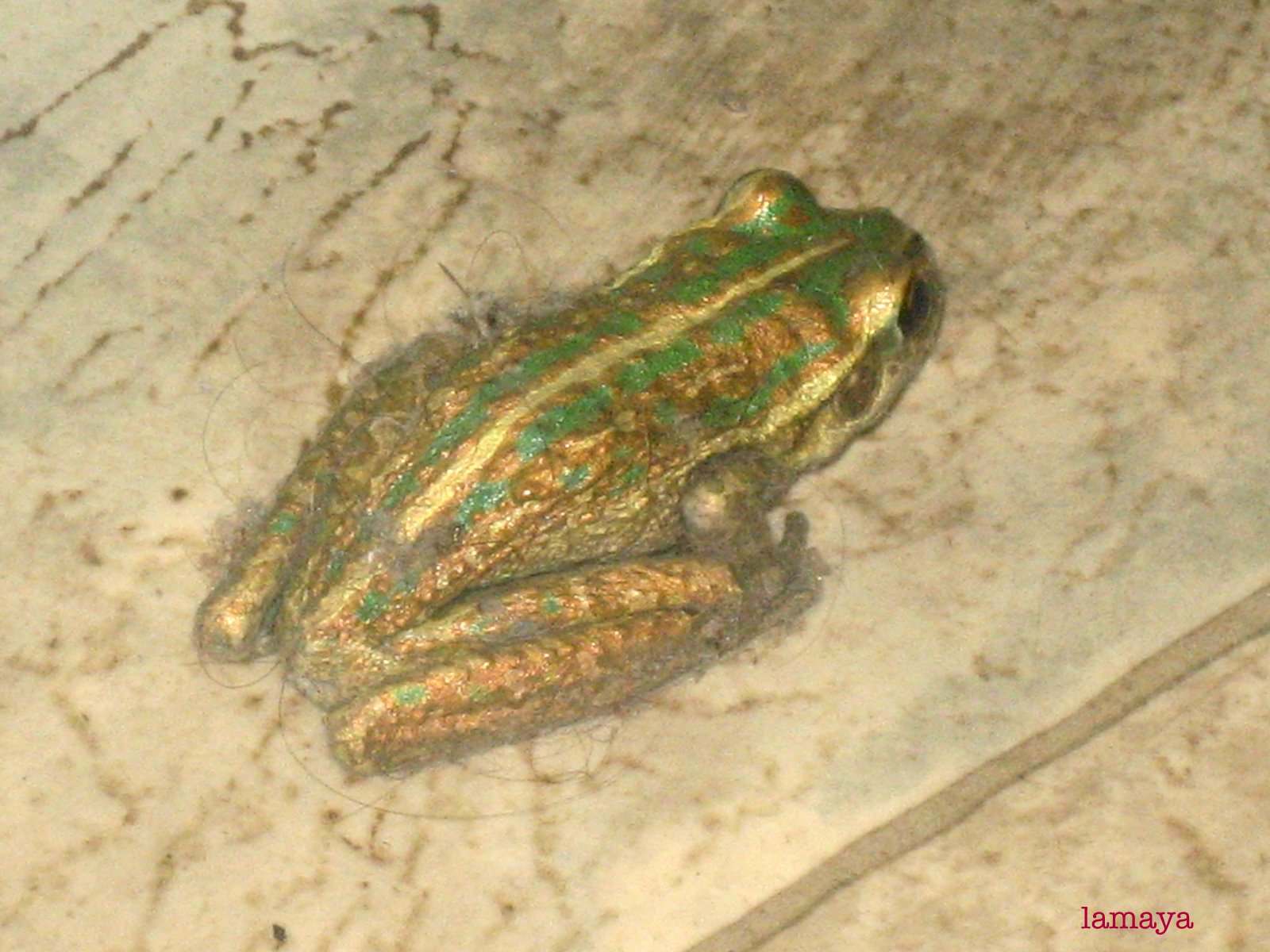
We based ourselves at the Pemberton Caravan Park.  Our ensuite cabin may not have been as luxurious as our room at the Karri Valley Resort, but we did get our own frog.  Since he was found hopping around the kitchen I wasn't sure if he was to be treated as a pet or as an entrée.  Once I finally caught him I released him back into the wild.  Actually, the Caravan Park was a very pleasant place to stay.  It is surrounded by tall trees and a river flows nearby.  Since we planned on being on the trails more than in the room it was a perfect place for us.
Of course, any trip to Pemberton wouldn't be complete without a visit to the Gloucester Tree.  The 61 meter  karri tree, which is located 3 km from the center of town, was once a fire lookout.  Today, thrill-seekers can visit the platform at the crown of the tree by climbing the pegs which, in 1946, were hammered into the tree's trunk to form a spiral ladder.
I decided to skip the birds eye view, since I could envision myself getting stuck half way up, and I didn't want to create a drama. Instead, as Mark gave it a go, I sat at the lovely picnic area. It wasn't long before I had company. However, my new found friend was not as well behaved as the parrot at the resort; this one was rather aggressive. So, if you're planning to visit and/or climb the Gloucester Tree you may want to picnic somewhere else.
There are actually a couple of other trees in the area that can be climbed, and you can get more information here.   By the way, I have heard that the view from the top is sensational.

Friday, August 6, 2010

Karri Valley Resort

Our arrival at Karri Valley Resort was not without drama.  We were tired and hungry, but were informed that if we wanted to eat in the restaurant we had less than half an hour before the last sitting.  We had envisioned a hot shower followed by a cold beer on our lake side balcony, but this wouldn't happen if we wanted to eat a warm meal. It had been a long day and we were both cranky, so we decided to skip the fine dinning experience and have a lakeside cold meal of surf and turf--tuna and beef jerky raided from our hiking provisions.  As we sat on our private balcony overlooking the Beedelup Lake it was soon became apparent that we had not been the first people to enjoy such a picnic as we were soon joined by an Australian Ringneck Parrot.   In the end we were happy with the dinning choice.  We couldn't have had a better view or been in a more peaceful location.


As night fell, our eyes drew heavy and we soon turned in.  I am not sure if it was the fact that Beedelup is derived from the Noongar word Bejalup meaning place of sleep or the 12 hour drive, but no sooner had our heads hit the pillow were we fast asleep.
We awoke early the next morning anxious to explore the surrounding forest.  We decided on a short pre-breakfast walk among the giant Karri trees.  I am not exaggerating when I say giant, since this variety of Eucalyptus tree can grow to be 90 meters tall.  A short path up one of the surrounding hills took us up to the Walk-Through Tree.  The 400 year old tree, which is over 75 meters tall has a 3x4 meter hole cut into its base.  It was pretty impressive to stand inside the tree knowing that there are more than 150 tons of tree above you.

After breakfast we returned to the forest.  Unfortunately, we didn't have a lot of time to spend on the trail since we had a long, almost 400 km, drive back to Perth.  But, we did spend a few hours walking through the damp and misty timberlands.  The understory was very lush and green.  A moss covered trail took us around the lake to Beedelup Falls.  Here we crossed a swing bridge which took us over the Beedelup Brook and provided a full on view of the water flowing over 100 meters over steep granite rocks.  The waterfall itself was not that impressive, however, we were astounded by the amount of water.  After all, this was not what we had imagined from the arid land of Western Australia.  As our time in the southern forests of WA came to an end we knew that we would return to spend more time exploring the area.

Saturday, July 31, 2010

A Public First


This week's PhotoHunt theme is public.
This Round House is located at Arthur Head in Fremantle, and  it is Western Australia's oldest public building.  The gaol (jail) was built in 1830 and it was the first permanent building in the Swan River Colony.
The small prison had eight cells and a jailer's residence.  It was used for colonial and indigenous prisoners until 1886 when the Convict Establishment prison was transfered to the colony.  After that, the smaller Round House was used as a police lockup until 1900, when it became the living quarters for the chief constable and his family.