Thursday, October 1, 2009

Kan see 'roo


This weekend marks the year anniversary of my first wild 'roo sighting.  I remember the event clear as day.  We were cruising down the Southern Expressway, when in my peripheral vision, I caught a glimpse of a kangaroo's ears bouncing above the barrier wall.  No wait, that was the ponytail of the runner with a serious spring in her step.  Oh, I remember...it was further down the road.  On the hillside in the distance, there it was hunched over--enjoying some nibblies.  No, that was a granite boulder in a field.  Ahhh, now I know.  It was that crazed blob bouncing from one side of the road to the other--unable to escape because of the high chain link fence.  That was it!!  Between my shrieking, "It's a roo, it's a roo!!," and the animal flying all over the road, it's a miracle Mark didn't wreck the car.  It was such an emotional moment that I almost pissed myself.
Since then, there have been hundreds if not thousands of 'roo views.  Mark calls me the kangaroo detector, and I can spot even the best camouflaged animal.  However, when Mom came for a visit I was very stressed that perhaps my new found ability would falter, and that I wouldn't be able to share a wild experience with her.
As I planned our "let's show Mum Australia" itinerary, I remembered that at one of the Expat in Adelaide meetings I was talking to Brett, who told me that if you wanted to be sure to see a 'roo to head down to Deep Creek Conservation Park on the Fleurieu Peninsula.  I decided to take a gamble, and take his word for it.  It turns out that Brett is not a lying man.  When we arrived at Deep Creek Conservation Park, an hour and a half south of Adelaide, we were treated to mobs of Western Grey Kangaroos.
There were plenty of these normally nocturnal animals lounging around or having a mid-morning snack.   The Western Grey Kangaroo, whose fur color ranges from grey to brown, loves the lifestyle of Southern living, and can be found in the scrublands and forests of Southern Australia.


At DCCP we saw fliers with their joeys.  We  observed some of the little joeys use their powerful hind legs to quickly hop and dive back into their mother's pouch when we came near.  Many of the moms would just rise on their hind legs, using their strong tails as support, and observe us.  There were also some boomers around.  At over 4 feet in height some of the bigger guys were almost taller than my mom, and I am glad that none of them tried to engage her in a boxing match.


As we left the Conservation Park, I was pleased that I was able to share the joy of seeing a Kangaroo in the wild with my mother.  I felt that it was the perfect Mother's Day gift.


Wednesday, September 30, 2009

The Lavender Federation Trail


South Australia has several long distance trails.  One of them is The Lavender Federation Trail, named after the late Terry Lavender.  The 105 kilometer trail begins at Murray Bridge (a mere 75 kms from Adelaide) and winds its way up to the Barossa Valley.  There are plans to extend it into the Clare Valley.
We have yet to explore this trail in depth, but this past winter we did get out and complete the Tungkillo Loop Trail, which is an extension of The Lavender Trail.
The head of the loop is located in Tungkillo on the Adelaide to Mannum Road. At 20 kms in length it was a perfect day trip.  We were able to complete the loop in about 6 hours.  There is parking in Tungkillo and the trail is easy to find since there are signs pointing you in the right direction.
We began the walk on dirt country roads, which took us through pastoral land and rocky outcrops.  Since we walked the trail in June, the landscape was a lush green.  The gentle rolling bright green hills contrasted magnificently with granite boulders.  This was the landscape that would accompany us for most of the 20 kms.


Pastoral Land & Granite Outcrops

About 2 kilometers into the walk we left the dirt road, and began to cut across fields.  For about the next 12 kilometers we were mainly on private land, but as long as we stayed close to the fence we were not trespassing.  This part of our walk included several fence crossing which were facilitated by conveniently placed ladders--it was great to not have to worry about opening and closing gates.


Conveniently Placed Ladder

Other reminders that we were on grazing land included herds of sheep and cows as well as signs announcing the shooting of feral animals.  In case we didn't believe about the shooting, fox carcasses were left hanging on the fences.


Fox Carcass

At about 14 kms  into our hike we left private property.  We walked the main road for about 1 km, where we once again joined a back country road to return to Tungkillo.

Tuesday, September 29, 2009

Close Your Eyes and Picture This....


Glenelg is well known for its sunsets.  We are fortunate to have an uninterrupted view of this daily event from our flat, and as often as possible I take a few moments to watch the sun dip below the horizon.  There have been very few days, in the last year, that I have been disappointed with Mother Nature's delightful show.
Yesterday I decided to go for a different perspective and headed down to the beach.  I was driven by a break in unstable weather, and wanted to take a pre-sunset walk along the water.  On my return I stopped along the seawall in-front of our flat to watch the last few rays of light disappear behind the surf.
My attention was drawn to the half dozen kayakers surfing the waves--something I had never seen at our beach--and ignored the people around me.  However, my attention was caught by the voice of the lady next to me.  I assumed that she was talking to a young child because she was describing our surroundings with rich, colorful language.  When I turned to look at them I was surprised to see that she was not talking to a child, but rather to another adult.  I thought it was a bit strange at first, but upon closer inspection I realized the listener was blind, and her friend was describing the scene before them.  I could not help but close my eyes and listen to the woman's voice.  Her choice of words, with a focus on detail, created a vivid picture in my mind.  Of course, I had had the advantage of seeing the scene she was describing before closing my eyes,  however, I am not sure I would have noticed all of the details that she included in her description.  For me it was a true lesson on the necessity to not just stop and observe, but to really search for the small details.
In the past year I have seen some amazing sunset moments on the beach.  There was the young man who dropped to his knee to propose to his girlfriend.  There were the boogie boarders who left their fun in the surf to lay in the sand and watch the changing colors of the sky.  There was the couple who framed the sun by creating a heart shape with their connected arms.  There were the young women who washed themselves in the sea before kneeling on the beach in prayer.  There was the pod of dolphins frolicking in the water.  Each of these scenes was touching in its own way, but none were as moving as what I experienced last night.

Monday, September 28, 2009

Burning Mountain


One day the Gumaroi Aboriginal people in the north sent a raiding party to steal Wanaruah women for wives. The Wanaruah people heard of the plan and sent their warriors to do battle with the raiding party. One of the wives of a Wanaruah warrior sat at the top of the southern rock face of Mt. Wingin to wait for her husband's return. When her husband did not come back because he had been killed in battle, the woman was so sad that she asked the great sky god, Biamie, to kill her. Biamie felt so sorry for the warrior's wife that he turned her into stone and as she turned to stone she cried tears of fire that set the mountain alight.
This dream story comes from the Wanaruah Aboriginal people of the Hunter Valley of New South Whales. It documents their relation to Burning Mountain, located about 300 kilometers north of Sydney, just off the New England Highway.
Burning Mountain is a a naturally ignited coal seam which is believed to have been smoldering for several thousand years. It is one of three burning coal seams in the world and the only one in Australia.
From the car park there is a short trail, flanked by interpretive panels, that leads you through a gum tree forest to a viewing platform at the barren summit. Here you can see smoke, hot sulphur gases, rising from the grey, smoldering ash, and you can not help but remember the Wanaruah Warrior's grieving wife.

(source-information panels Burning Mountain Nature Reserve)

Sunday, September 27, 2009

Passion Fruit


As I entered the market I was greeted with the enticing aroma fresh passion fruit. I just had to buy a bag and take them home. Once home I had to decide what to do with them. After searching through several recipes I decided on Australian Chef Matt Moran's Baked Passion Fruit Tartlets. They turned out to be a tasty treat.

Baked Passion Fruit Tartlets
(Serves 6)


3 eggs
1 egg yolk
150 gm caster sugar
150 ml pouring cream
200 ml strained passionfruit pulp, from about 20-30 passionfruits
To serve: icing sugar

Sweet pastry
225 gm unsalted butter
100 gm icing sugar
375 gm plain flour
1 egg
1 egg yolk, lightly beaten

For the pastry, mix the butter, sugar and flour in a food processor until the mixture resembles breadcrumbs. With the motor running, add the egg and combine until a dough forms. Wrap in plastic wrap and allow to rest for 2 hours in the refrigerator.

Preheat the oven to 160C. On a lightly floured surface, roll out the pastry to 3mm thick and use to line six 8cm-diameter tart tins, then place in the refrigerator for 20 minutes. Line pastry-lined tins with baking paper, then fill with pastry weights, dried chickpeas or rice, and blind-bake for 15 minutes. Remove weights and bake for another 5 minutes or until golden. While still warm, fill any cracks with leftover pastry, then brush the insides of the tartlet shells with the beaten egg yolk and return to the oven for 3 minutes or until lightly browned. Remove from the oven and allow to cool.

Reduce the oven temperature to 120C. To make the filling, lightly mix together the eggs, egg yolk and caster sugar in a bowl until sugar has dissolved. Stir in the cream and passionfruit juice and then strain through a fine sieve into a jug. Pour the filling into the tartlet shells and bake for 10-15 minutes or until just set – the filling should still wobble slightly in the centre. Leave to cool to room temperature.

Just before serving, dust the tarts with icing sugar and caramelise with a blowtorch or under a very hot grill.

Saturday, September 26, 2009

Twisted


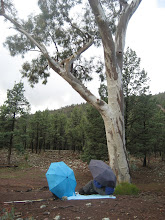
This week's theme is twisted.

This photo was taken in May at Barrington Tops National Park. This World Heritage Area is located in New South Wales, about 5 hours from Sydney. The park has various hiking trails and a varied river environment, as well as a sub tropical rainforest. Over 70% of the park is mature old growth forest.

Friday, September 25, 2009

I've Been Everywhere Man...


Recently I visited The Social Primate's blog, and learned that Johnny Cash's "I've Been Everywhere" is a remake of an Australian song that was written by Geoff Mack in 1959. We have listened to the Johnny Cash version for several years. I would have loved to have known about the original on our road trip to Coober Pedy since it begins, "Well, I was humpin' my bluey on the dusty Oodnadatta road"--and it was the Oodnadatta track that we took to return to Adelaide.
I never imagined that our Down Under adventures would include a 600+ kilometer drive, on an unsealed road, across the isolated Australian Outback. I am not sure that we would have ever taken the Oodnadatta track except for two things:

1. My birthday wish to see Lake Eyre--an obsession that began with the stories of explorers who crossed the Australian desert carrying a wooden ship, in search of the great inland sea--launched us on this adventure.
2. The Pink Road House--a couple of mates in the bush who own this place gave us the information and courage that we needed to embark on the journey of a lifetime.


We didn't traverse the entire historical trail from Marla to Maree. Instead we began in Coober Pedy and connected with the Oodnadatta at William Creek. William Creek was very important on our trip, not because it is home to the most isolated Pub in the world, but because it is one of the only gateways to Lake Eyre National Park. As we walked around the town of 12, we had to decide if we would climb aboard the small airplane for an aerial view of the lake, or drive 60 kilometers on a 4wd road. As tempting as it was to look down over the vast salt lake, which was filling with water for the first time in many years, the wind and price proved too much. So down a bumpy road we headed.


As we stood at ABC bay and looked out across the vast salt plain in front of us, I could almost see the sea that the explorers were so desperate to find. Perhaps they stood in the very same spot and realized that their search had not been in vain--that they had just arrived several thousand years too late.
At our next stop Halligan Bay, we were once again reminded that we were standing on an ancient sea bottom when we were greeted by a lone seagull. As we slowly crunched our way across the surface, I realized it didn't take a vivid imagination to mistake the desert's undulating, deceiving dance for sparkling water. The wind ruined our plans for a lakeside picnic, so we ate a quick lunch in the cab of our monster SUV, before resuming our journey.


After an hour of very rugged terrain we rejoined the Oodnadatta track. We faced a long afternoon drive, one that was isolated in terms of company (human and animal), but full of history and natural beauty. The track itself was an old Aboriginal Trail that was also used to run cattle from north to south. At one point in history the renowned Ghan, the train that runs from Adelaide to Darwin, followed alongside the dirt road. In some spots you can still see the skeleton of the old tracks. Brown signs indicate roads to the original Homesteader plots, a reminder that this rugged land is still called home for some. One of these residents had built a sculpture garden alongside the road.
As we crossed the dessert, we passed painted cliffs, towering red sand hills, and several oases. The meandering riverbed was dry, but there were several springs. As the afternoon wore on we once again came into contact with Lake Eyre. We had reached the southernmost part of the lake and found ourselves 12m below sea level.


Just as the sun began to sink, into the horizon, we arrived in Marree. We were greeted at the Caravan by a friendly bloke who invited us to join the other travelers at the barbie for some evening tucker.