Showing posts with label australia. Show all posts

Saturday, January 14, 2012

Circular Key


This week's PhotoHunter theme is circular.

A visit to Sydney wouldn't be complete without calling into Circular Quay. In Australia Quay is pronounced key (thus today's title).

Wednesday, July 13, 2011

Overland


Our start of summer had been different than other years. Rather than being faced with dry, hot campgrounds we had been faced with flooded, swampy areas. On Christmas Eve, as we sat next to the river that had exceeded its banks, we never imagined that the excess of water in the drought stricken area would carry on into the heat of summer. We expected that with the arrival of the soaring temperatures the abundance of water would quickly dissipate leaving the land in a dry and barren state.There was no way that we could predict that the multitude of storms that were besieging the northwestern part of the country, thousands of kilometers away, would keep the rivers flowing at above normal heights in our neck of the woods. As I watched the flooding in Queensland on television, cars being washed away by powerful rivers, it all seemed so far away. I never dreamed that in less than a week's time I would come in contact with the same waters.
With Australia Day on the horizon we set out for a long weekend in Melbourne. I decided to travel by the Overland train, not because it was less expensive than flying, but because the 10 hour ride would allow me to sit back and enjoy the countryside. Unfortunately, my trip was not as stress free as I had hoped. Less than 24 hours before I was to embark on my journey not only had the floodwaters from the north had arrived in the state of Victoria, but local storms were exacerbating the situation and causing travel havoc. Roads were being flooded and closed. Fortunately, the railway remained unaffected and we had an on time departure. 
Just hours into our trip the impact of the recent rains became visible, as the countryside began to green up. As we traveled westward, towards the Grampian Mountains, the bucolic scenes of the pastoral wheat-belt turned into a swampland. The flooded fields and washed out roads were the result of an excess of rain, and the water had no where to escape. 


As we approached the banks of the Wimmera River, the train was no longer surrounded by stagnant pools of water, but rather a free flowing river. As we slowed to a crawl an announcement was made that the river had begun to flow across the tracks. Thankfully the waters were relatively tame, and we were able to continue on our journey without too much drama.  However, as I looked out the window and marveled at the water disappearing below our train, I couldn't help but be awed by Mother Nature.

Thursday, June 16, 2011

Eye C U

Last February, when my mom finally bought her ticket to come and visit me in Perth I was thrilled. I was excited that not only we would be able to spend some quality time together, but that I would be able to share my new home and life with her. This wasn't her first trip to Australia so we would skip the touristy stuff and I could focus on showing her my day to day activities, as well as all the small things I love about the place I currently call home. In anticipation of her visit I decided I wanted to take her camping, after all, the bush has been such an important part of our life.  There would be no dramas since we have an extra tent and sleeping bag, and I figured we could always rent a RAV4 and she could sleep on the back if need be. As Mom's trip neared the days became shorter and winter began to settle in. A few weeks before her arrival the not only did the temperatures dropped and the rains arrived; I realized that camping with Mom would not be a joyful experience. So, we decided to go with plan B and show her how we experienced the Australian Bush before we dished out 25 buck for our tent--a night in an Ozzie  Caravan Park.
It was just our luck that just up the road in Cervantes was a Caravan Park we had previously visited. The place had been clean, and had all the amenities to provide a true experience. Unfortunately, the place was all booked up. So we moved on to plan C. We decided to stay with the destination because of its proximity to the Pinnacles, but we didn't want to pay to stay at the overpriced hotel in town. We remembered from our previous visit that the town boasted a Backpackers accommodations.
I was in a bit of a quandary and I had to question if I really wanted to put my mom through a hostel experience. I had only stayed at one Backpackers in Australia and it was extremely clean and comfortable, but I couldn't shake the vision of some of  my less that stellar experiences in Europe--like the place I stayed at the first year I moved to Granada. The University had recommended it as an ideal budget accommodation to stay at while we looked for apartments, but perhaps exotic would have been a better description. Sure, the centrally located Hostal was very clean and the family that ran the place were very nice and made you feel like part of the family. However, things became a bit too friendly when, during one of my curtainless showers, I became the star of a peep show. The door which was missing a door knob had a wad of toilet paper stuffed in the round hole, and half-way through my shower a human eye replaced the paper.
I put my past experiences aside and after much deliberation, we decided to give the Cervantes Backpackers a go since it would be for just one night. Besides the room  had its own ensuite, whereas at the Caravan Park we would have had to to make the midnight dash across the park to the Ablution Block.
As it turned out there was no need for the earplugs I had packed, as there were no drunk young'uns running around to all hours of the night keeping us oldies awake. In fact, we pretty much had the immaculate place to ourselves, and our room even had a view of the Indian Ocean and Mom was a happy camper.

Saturday, April 9, 2011

An Australian Native

This week's PhotoHunt theme is trees.

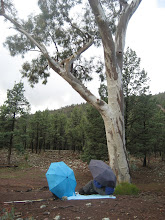
The classic Australian tree would have to be the Eucalyptus. There are over 700 species of the tree and they can found across the entire continent. Eucalyptus trees are evergreens, but many species shed their bark--like the tree showcased this week. 

Saturday, January 29, 2011

A Hand Stand


This week's PhotoHunt theme is standing.

When I saw this sculpture in Melbourne I wanted to use it for last week's PhotoHunt, but I wasn't able to download the photo to my netbook. Luckily the photo works well for this week's theme as well.
Standing high above Melbourne on the lawns of The Sidney Myer Music Bowl is the "Hand of God" by Carl Milles.

Tuesday, January 18, 2011

Bee Feral

We were closer to home, but with 400km still in front of us we decided to stop for the night. We pulled out the map and decided that the Murray Sunset National Park looked like the best place to camp. We figured that its isolated location, vast y spaces and lack of water would provided us with the solitary bush experience that we have come to love. After all who would travel hundreds of kilometers to camp next to a dry salt bed in the middle of summer. 
We were disappointed when we pulled into the campground to see a few other tents, but fortunately they were all congregated next to the long drop. We were able to find a campsite without neighbors.
As we pitched the tent we noticed that there were a fair number of bees flying around. This was a bit of a concern since I am allergic to bee stings. Fortunately, our tent is easy to assemble and I quickly took refuge, hoping that as the sun set on the horizon the bees would also disappear. As Mark continued to set up camp, I was leafing through the Park's brochure, and there in the top right hand corner was a warning of feral bees. Apparently, some of the exotic honey bees that were introduced into Australia over 170 years ago have escaped and become a pest. They especially become a nuisance during the summer months when they aggressively seek out water to cool their hives. Further reading informed me that it isn't just H20 that they are attracted to, but that they love human perspiration. I didn't need to read anymore. I knew that even with my EpiPen nearby I still did not want to experience an allergic attack should I be stung. I had no choice but to imprison myself in our tent.  Mark couldn't have agreed more; truly, he dreads the day when we are hundreds of kilometers from anything and he has to stick me in the leg with epinephrine. 

Monday, January 10, 2011

Then I Saw It Fall. Now I'm A Believer.

On one of our first trips to the Australia Bush we came a across a sign that warned of falling limbs. At the time we found it a bit comical and I had to snap a picture. As we moved into summer the same warning started turning up all over the place. In fact, I even heard a reminder on the local radio station. I found it strange since the days were becoming longer and hotter, not windier. So when visiting the Adelaide Botanic gardens I took the opportunity to ask an expert about the warnings. 
It turns out that it is not uncommon for the Australian Red Gum to drop a limb, especially when it is hot out. So I was once again told to keep my eyes up, ears open and not sit or camp under large trees when in the bush. We heeded the warning and for the next two years we kept a look up, especially when parking our rental cars--didn't want to have to explain a crushed roof. However, after countless hours spent in the bush and walking along the tree lined streets of Adelaide I had yet to personally witness a falling limb and I couldn't help but wonder if the warnings were valid. But we still continued to park the car out in the open. This is not always easy, as I hate to keep the vehicle in the sun especially in the summer.
So during our Christmas road trip as we slowly worked our way across the low lying hill surrounding the Snowy River, I tried to convince Mark we needed to park in the shade. He refused and parked smack in the middle of an open clearing. Having lost the battle I grabbed my towel and headed to a grassy area under the trees for a pout while Mark headed down to the river for a dip.
I sprawled out on my large beach towel and closed my eyes. I was quickly blanketed with the thick warm air. I was surrounded by an eerie silence. The buzz of flies, calls of birds, and even the babble of the creek were muted by the soaring heat of the day. Suddenly the silence was broken by a loud crack. Just to my left a very large branch came crashing to the ground. In one brief moment Mother Nature had converted me into a believer. 

Friday, January 7, 2011

All In A Day's Drive

It wasn't dreams of Santa's gifts that brought about our Christmas Day predawn wake-up. Instead it was the boisterous calls of the dozens of birds that had flocked to the swollen banks of the Murray River. From the chirps, tweets, whistles, quacks, coos, chatter, squeaks and laughs I could only assume that these jolly birds were rejoicing  the arrival of water in a drought-stricken land. The abudence of water had left the air thick with humidity, and our environment reminded us more of the bayous of New Orleans that the southwest corner of Victoria.

We quickly took down our campsite, partially because of the mozzies but also because our next destination lay over 10 hours away. We anxiously hit the road, excited to discover the surprises the twisty journey would bring.
Even though we soon left the river--bursting at its banks--behind us, the impact of the recent record rains remained visible. With each flooded field and/or washed out side-road we passed, I couldn't help but feel that too much of a good thing had arrived too late. That even though there was some greening up of the heartier vegetation no amount of water would be able to bring back to life the crisp skeletons of trees and vegetation that lined the horizon. There would be no salvaging the ineptly planted, water dependent, cotton crops, which had been abandoned long ago because their yields were too small to be profitable, yet large enough to create a Christmas Day snowlike storm in the middle of Australia.
Late in the afternoon, as we approached the Great Dividing Range, the scenes of destruction disappeared. As we slowly began to climb, the landscape turned from burnt brown with speckles of green to a countryside slashed with various hues of green. It was obvious that this part of the country had not suffered from lack of water and that the recent abundance had just added to the lushness.
Our final destination, high in the snowy mountains, was very distinct from the swamp lands where we started over 9 hours and 700 kilometers earlier.

Saturday, December 18, 2010

Man Vs' Mail


This week's PhotoHunt theme is male.

A couple of weeks ago, while visiting Kangaroo Island, we came across an interesting collection of (māl)boxes.

Friday, December 17, 2010

Face To Face?

My time in croc country was quickly coming to a close and I had yet to see the world's largest reptile. I had seen plenty of signs, warnings, and even an imprint--but no sightings of the elusive animal.It was for this reason that we broke up camp at 4:30 am in the pitch dark. I energetically encouraged Mark to hurry up, since I didn't want to miss the boat. I anxiously anticipated that our trip along the Yellow Water Billabong would finally put an end to my quest to spot one of the terrors of the north. Unfortunately, the tour operator had assured us a unique experience--lots for birds and magnificent flora--but could not guarantee a face to face encounter with the ferocious giants.
Along with several dozen other bleary eyed travelers we stood in line to board the bus that would take us to the boat ramp. It appeared that most of our fellow passengers had spent the night in the lodge or taken a morning shower since they frantically swatted at the millions of mosquitos that descended upon us. Fortunately, in the predawn hours, we had used plenty of Off before we even left the tent. As a result it was the first time in 12 hours the pesky bugs were ignoring us--they had plenty of other sources to quench their bloody thirst.
The short road to the dock remained flooded--the remnants of a wet season that had extended well beyond its normal period. I couldn't help but wonder if the high waters would increase our chances of seeing a croc. Just as we boarded the boat the sun began to make itself visible on the horizon. As it made its gradual climb in the sky it brushed the grey canvas with various shades of reds, yellows and oranges.


As promised our cruise through Kakadu's most famous wetland, Yellow Water Billabong, was fruitful-- White Bellied Sea Eagle, Australian Darter, Ibis, Kingfisher, Kingfisher, Whistling Ducks, Jacana, and Jabiru were all spotted. The sing song of the different species of birds added a musical symphony to the painted landscape that lay before us--a work of art only achievable by mother nature.
Of course, for me the highlight of the trip was the sighting of several crocs. The first one was a very large male who became agro and began swatting the water as we approached. Even from a distance I was amazed by his size  and happy that we hadn't run into him on the trail. Just before we turned around and headed back to the docks a spiny back broke the lagoon surface just in front of us; he was lovely enough to hang around for some photo ops. 

Wednesday, December 15, 2010

If It's Not A Croc, It's a Boar

Our plans to stay at Jim Jim Billabong were foiled because the isolated camping area was still closed to the public. Instead we pulled into Gagudju Lodge at Cooinda. One quick look at the campground and I knew that there was no way we would be staying the night with the masses. Dozens of Campervans and Caravans were parked one on top of another in a fenced off area. It was like the parking lot of a major mall at Christmas time, but rather than parking and rushing off into the semi-pathetic mini-mart, heaps of of Aussies and Tourists were all lounging about in front of their temporary mobile homes. From my vantage point, outside the massive chain-link fence, the campers resembled caged animals and I wondered if they felt entrapped or protected. 
We quickly filled the RAV4 with petrol and decided to call in to the information center to find about river trips. We had hopes of catching an early morning boat ride before continuing on our way to Darwin. We were in luck; the dawn tour had space. But, of course it did, since it cost $30 more than all the other river tours because it included breakfast. I knew the last thing I wanted was to spend way too much for a meal that would consist of greasy eggs and stinky sausage, but I really wanted to see the river and its wildlife at dawn. So we coughed up the money, and headed down the road to the National Park Campground.
We were unsure of what we would find, but to our relief the large campground was virtually empty. I was also happy that the generator free area was at least a 1/2 mile from the Mardugal Billabong, home to--yep, you guessed it--crocs. We found the perfect spot to pitch our tent and settled into enjoy the evening. Unfortunately, it wasn't long before hell descended upon us as millions of mosquitos came out for a feed. We were able to protect our skin with long sleeves and spray, but there was nothing we could do about the insistent drone--a noise that would stay with us throughout the entire night as the little buggers tried to make their way into the tent. And this cacophony  was interrupted  only by the distant howl of a dingo, and the snort of the wild pig that crashed through our camp in the middle of the night. As we followed the clackety clackety sound of his hooves against the ground through the bush, for a picture that wasn't captured, I began to wonder if perhaps there was a reason to stay within in the perimeter of the shiny silver cage just up the road.


Monday, December 13, 2010

Southern Kakadu Water Falls

We were headed to the more visited northern part of Kakadu, we decided to stop and stroll among the southern hills and ridges of the less visited part of the park one last time.
There were a few cars at the Yurmikmik carpark, but the occupants had already hit the trail. Originally we had hoped to hike the Motor Car circuit walk, but since parts of the walk followed the South Alligator River, where crocs were a plenty, we decided to just do the linear walk to a couple of different falls.
After crossing a swing bridge across the Plum Tree Creek we soon found ourselves in a monsoon forest. Giant Fan Palms lined the trail which followed a dry creek bed. When we began to scramble over large conglomerate and sandstone boulders we knew we were on the wrong path since we were supposed to be following a historical vehicle track--so we back tracked several hundred meters to where we had made the wrong turn.
The correct trail, which was first driven in 1946 by Paul Allmich in his Chevrolet truck, was easy to follow and it wasn't long before we were at the turn off to Motor Creek Falls. At this point there was a large group on the trail in front of us. We took advantage of them pausing for a break and quickly passed them. This was fortunate since the trail became much more technical and I would not have wanted to be stuck behind a large pack of people.  When we arrived at the towering canyon wall we were a bit taken back. Nothing had prepared us for the emerald green water that lay in front of us. We sat on the edge of the pool admiring its beauty and understanding why so many people are drawn to the Northern Territory. It wasn't long before the serenity was broken with voices and we knew it was time for us to carry on to Kurrundie Falls.
We retraced our steps to the vehicle track and continued on our way. The noon time temperatures were starting to soar. The open woodlands that we were traversing provided shade from the sun, but there was no escaping the oppressive heat. In the distance we could catch glimpses of white water cascading down the front of the brown rocky ridge--our destination. 
Once again we were required to leave the well defined track. It was obvious that this part of the trail didn't get much traffic and the single track was hard to follow in many areas. Fortunately, from our vantage point high on a plateau we were able to use the very full Kurrundie Creek as a guide. Unfortunately, the trail soon dropped us down to the riverside. Of course we could still use the river as a guide, but I was more concerned that the thick vegetation would be a perfect place for a croc waiting for lunch to come by. Since there wasn't much of a trail we ended up walking higher up along the side of the hill where we could see any dangers that lurked in the water.  
Unlike the previous perfect water hole we had visited, the Kurrundie pool was nestled high on the cliff side. There was no protection from the sun. It was impossible to reach the water to take a dip. It wasn't the perfect spot for a lunch break, but our stomachs were grumbling. So we found a rock where we could comfortably eat our lunch. It wasn't long before we had company, but this time instead a large group of loud tourist we were joined by a circling Peregrine Falcon--the perfect guest for our picnic.

Thursday, November 11, 2010

Lest We Forget


Today I was once again reminded of the armistice which ended the First World War. At 11 am my pilates class observed a minute of silence in memory of those who died or suffered in all wars and armed conflicts. 
In my travels across Australia I have yet to visit a town, no matter how small or isolated, that did not have some type of commemorative war memorial. However, it is each November 11th when I watch those around me--whether it be in a pilates class, at the botanical garden, or on an airplane--that I am reminded of just how seriously Australians take remembering those who have sacrificed their lives.

Saturday, November 6, 2010

Staying Alive In The Bush


This week's photohunt theme is alive.

Since 1928 the dream of uniting medicine, aviation and radio have been used to keep people "alive" in the remote Australian outback.
The Australian Inland Mission Aerial Medical Service began with a single-engine airplane chartered from QANTAS. The service provided a sense of safety for the inhabitants of the remote areas of the continent as 2 doctors brought the only medical care to the area of almost 2 million square kilometers. 
The name of the operation was changed to the Flying Doctor Service in 1943, and within ten years, with the Queen's approval, Royal was added to to the title.
Today the Royal Flying Doctor Service (RFDS), operates with 53 fully instrumented aircraft from 21 bases across Australia. Each year the RFDS pilots fly the equivalent of 25 round trips to the moon, allowing doctors and nurses to care for nearly  270,00 patients. The dedication of this internationally recognized Australian Institution ensures that people across the continent are guaranteed quality health care.

Friday, October 22, 2010

Gosses Bluff

Uluru, Kings Canyon, and Alice Springs are common destinations for visitors to Australia's Red Center. All three of these "must sees" make the distance traveled to arrive at the center of a very large continent well worth the trip. But visitors should take a few extra days for some outback exploration, because there is plenty more out there. 
I strongly recommend Gosses Bluff, a crater-like formation that measures 5 kilometers in diameter and 150 meters in height, located 175 km west of Alice Springs. It is believed that the rock-rimmed hole was created millions of years ago when a very large comet or meteorite crashed into the earth. The original scar would have measured 22 kilometers in diameter, but over time erosion reduced it to it's present day size.

For the local Western Arrernte Aboriginal People, the site is known as Tnorala, and it is a sacred place. The traditional owners of the land believe that Tnorala was formed when a group of women danced across the sky as the Milky Way. During this dance a mother put her baby to rest in its wooden baby-carrier. The carrier toppled over the edge of the dancing area, crashed to earth, and forced the rocks upward, forming the circular mountain range. The baby's parents, the evening and morning star (Venus) continue to search for their baby.
Tnorala (Gosse Bluff) is a day-use area, with picnic facilities and short walks.

Monday, October 18, 2010

Bojangles

A visit to the red center wouldn't be complete without a visit to Bojangles in Alice Springs. The historic venue first opened its doors in 1935 as a guesthouse that offered accommodation and basic hospitality. Over the years the establishment has evolved to its present iteration, a popular watering hole.
Few visitors to Alice can resist the beckoning call of the red swinging saloon doors. As patrons pass over the threshold they are transported to a distant time to find themselves surrounded by guns, boots, motorbikes, pioneering artifacts, taxidermy, bones and photos. 
Once patrons have perused the impressive collection of wild west mementos they can belly up to the bar for a coldie and some peanuts, or settle in at one of the communal tables for some distinctive outback tucker--camel, crocodile, kangaroo or emu. 

Thursday, October 14, 2010

Wanyu Ulurunya tatintja wiyangku watima

Most visitors to Uluru are happy with a photo in front of the picturesque rock. However, there are those who arrive at this World Heritage site with the goal of conquering Mother Nature by climbing to the tip of the monolith. 
To bag the peak, trekers must follow the traditional route that is a Dreamtime track--a pathway used by the spiritual ancestors of the Anangu people. The route holds spiritual significance and it is for that reason that the Aboriginal owners ask visitors not to climb the Uluru. It is not illegal to climb the sandstone formation, and many people, ignoring the traditional owners' plea, make their way to the top anyway. 
Prior to my visit to Uluru I was unclear of why the traditional owners didn't just prohibit the climb. I have since learned that even though the land was returned to the Anangu in 1985, they have since leased the land back to the government for 99 years. The lease included a promise that climbing Uluru would be banned; however, the climb remains open. Each year tens of thousands of people make the ascent. Unfortunately, over 35 people have died making the dangerous climb.
When visiting Uluru, I found the legality of climbing Uluru irrelevant. Even though I am an avid peak bagger I felt that my respect for the local culture easily outweighed my desire to climb the monolith. 

Wednesday, October 13, 2010

Tip Of The Monolith

Most people would probably be stumped if asked to give an example of a monolith. However, show a picture of Uluru rock and most people can easily identify one of Australia's most most famous landforms.  Of course, most Piranpa (non-Aboriginal people) will refer to the famous image as Ayers Rock, but the Anangu (Aboriginal people of the western desert) prefer that the spiritual landform is called by its native name Uluru.

Each year almost a half a million visitors make the long journey to the center of Australia to visit Uluru. Most visitors have seen pictures of the majestic, rich red sandstone mound change colors during sunrise and or sunset and they come to watch and photograph Mother Nature's light show in person. However, no matter how many pictures they have seen most will become overwhelmed by the spectacular event and many will leave touched in a way they never expected.

Viewing Uluru from a distance is just the tip of the monolith--literally. The 348 meter high rock actually extends several kilometers below the surface of the ground. Visitors are encouraged to become acquainted with the area walking the perimeter of the rock. The 9.4 km trail takes between 3-4 hours. As visitors make their journey around one of the greatest wonders of the world they are treated to an ever changing landscape. Similar to the shifting colors in the early morning or late evening light, each step walked brings subtle changes in the rock face--there are no two views that are the same.

Monday, October 11, 2010

You Take My Breath Away

We arrived at the trailhead just as the sun was peaking over the horizon. This time of year heat was not as great a concern as it would have been in high summer. We arrived early that cool autumn morning; not because we were trying to avoid the heat. Rather, it was the 4 hour drive that lay ahead of us that had forced the predawn wake-up. We hoped to spend at least a few hours on the trail before continuing down the road to Uluru.
As I strapped on my backpack I was relieved to have arrived so early. I knew that as the sun climbed high into the sky the solitude that we were about to be offered would quickly disappear as the throngs of day trippers arrived at Kings Canyon. Our goal was to quickly hike the 6 kilometer Rim trail, and then hopefully have some time on the Ernest Giles Trail. We needed to be on the road no later than one o’clock if we were to arrive at Uluru for the world famous sunset.
The trail quickly took us from the canyon floor up towards the rim. It didn’t take long to understand why so many refer to the 500 step climb Heart Attack Hill. Had the climb not taken our breath away the panoramic view from the top would have. In addition to an unobstructed 360° view we were also able to peek down the 270 meters to the canyon floor. We stood in silence as we contemplated how the forces of nature had etched the amazing landscape that lay before us.

As we walked the rim we became aware that the masses of humanity had arrived. Fortunately, the trail is only one way, and we were at least an hour ahead of anyone else.
In just over an hour we reached the intersection of the Rim Walk and the Earnest Giles Track. For once, time was on our side, and since we were well ahead of schedule we had a couple of hours to explore the 21 kilometer trail. As we followed the meandering path that lead away from the towering wall of the grand canyon the solitude stolen by the masses behind us soon returned and our only company was spinifex pigeons. With each step it became more and more obvious that the long distance track was not well traveled and we assumed that we had left the highlight of the park behind us. Thus, we were completely taken by surprise when the rugged canyon walls were replaced by dozens of mounds. For as far as we could see we were surrounded by the 100- meter tall, beehive-like formations. I was reminded of the structures built by the pre-Columbian cultures of the Americas and it was almost unbelievable that such landforms could be created by anything other than man. The trail gradually climbed and soon we were able to observe the landscape from a heightened vantage point. The rippling red rocks that lay before us we unlike anything I had ever seen. Once again I found myself breathless, but this time not from the climb. It was the majestic landscape that lay in front of us that took my breath away.


Sunday, October 10, 2010

King Style Accommodations

When visiting Kings Canyon in central Australia there aren't a lot of choices of places to bunk down for the night. Our visit to the area included a stay at the Kings Creek Station located 36 miles from the park. Guests at the working cattle/camel station are able to camp, or for those that don't have camping gear stay at a Safari Cabin. The permanent canvas cabins consist of a steel frame, canvas walls, and a solid floor. They don't have an en suite bathroom, but there is electricity and there is even a lockable door. Additional facilities include a shared toilet and shower block, kitchen, grassed picnic area, swimming pool and fire pit (the perfect place to share yarns after a long day of exploring).

Kings Creek Station was established in 1982 by Ian and Lyn Conway. The original land had no infrastructure and it was developed as a station to run cattle and export camels. However, over time tourism has come to have an important role on the property. Today, not only are accommodations available, but there are also helicopter flights, as well as camel and quad safaris.
The prime location, at the foot of the majestic George Gill Range, makes the 2,000 square kilometer Kings Creek Station a good place to experience the natural bush of the outback.