Showing posts with label adelaide. Show all posts

Friday, November 19, 2010

A Cruise With Temptation

It is not uncommon to see dolphins swimming in the waters around Glenelg. On a cool fall morning last year I headed out on Temptation Cruises hoping to get a closer view of the magnificent animal. I am not much of a water lover, so I skipped the opportunity to swim with the dolphins, though there were a couple of brave souls that took to the waters. The cruise was a success and in the 3.5 hours that I was aboard the 58ft catamaran I saw over a dozen different dolphins

Most of our sighting were of bottlenose dolphins. Some of the mammals were on their own and others were in pods. The color of the bottlenose dolphin varies considerably, but generally this type of dolphin is light to slate grey. In our waters these animals can grow up to 2.8 meters long and weigh as much as 270 kilograms. The South Australian bottlenose dolphin’s diet primarily consist of fish and squid. They eat approximately 8 kilogram each day. They generally hunt individually, but when a food source is found pods will work together. I am glad that I did not resist Temptation, a memory that will last a lifetime.

Wednesday, November 17, 2010

Mt Crawford

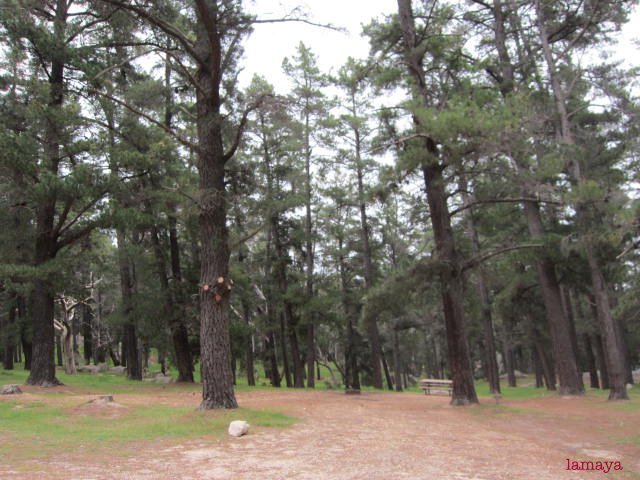
A couple of weeks ago our hopes of spending the day on the trail were washed out by torrential spring time rains. Instead, we decided to spend the day driving the back country roads, exploring the Adelaide Hills area. To our surprise, less than an hour from town we came across Mount Crawford Forest Reserve, a wooded area that offered a variety of hiking trails and several camping areas. We decided that, weather cooperating, we would return the following weekend to camp and do some additional exploring.
Mother Nature was on our side and the following weekend we headed for the hills. We decided to try our luck at Rocky Paddock, a fairly large campground nestled amongst an old pine plantation. When we arrived there were a couple of other campers nestled amongst the rocky outcrops. We headed to one of the more secluded edges and pitched our tent. We could only hope that no one would come along while we were out on the trail and set up camp right next to us. Once we had our territory staked out we hit the trail. 
The land, which was bought in 1909, has been used as eucalyptus and pine plantations since 1914. Currently 70,000 tons of timber is harvested annually from the area.  A variety of trails and tracks allow visitors to meander through a varied of landscape of eucalyptus, pine and native bush. Of course, since the trails traverse plantations, the tree groves are in different stages of the logging process. During our 5 hour loop we were treated to a walk amongst baby pine trees and some lumbering giants, as well as offered an opportunity to first handedly observe the destructive nature of the logging industry. The highlight of the day was our climb of Little Mount Crawford, where the land around the 525 meter peak has been left in its native state.
Mount Crawford Reserve is the perfect place for a day-trip or an overnighter. In addition to three camping areas that offer basic facilities there are numerous picnicking areas. However, visitors need to be aware that camping is only permitted from April through November, and there are strict fire restrictions. For more information about the area visit http://www.forestry.sa.gov.au/crawford.stm.

Monday, September 6, 2010

A Fair Show

This past week was the Royal Adelaide Show--aka "The Show" by locals. Two years ago, with less than a week in Adelaide,  I met people who kept insisting I go to the 9 day event. When I asked for a description of The Show I was told about can't be missed amusement rides, tasty treats, and bags.  At the time, the description and the relatively high price tag didn't put the event on my must do list.  Then, last year, with a year of living in Adelaide under our belt, we understood that The Show was what we would call a Fair and consisted of more than deep fried food and roller coasters--though the concept of bags still baffled us. Finally we decided that since we live in a state built on agriculture we decided we needed to mosey on down to the Royal Adelaide Showgrounds for the annual event. 

We were not disappointed as we walked the barnyards and pavilions admiring the state's farmers prize-winning livestock and produce.  We sat in the crowds, cheering on competitions of beauty and strength, for man and beast--horse riding, dog shows, and wood chopping (just to name a few). We had our fill of demonstrations--cooking, sheep sheering, cattle milking and iron-smithing.  

We rounded out the agricultural part of the experience with gourmet food and wine tasting, live entertainment, and art shows. We also put an end to the bag mystery, as we were provided the opportunity to buy promotional themed plastic bags filled with items that ranged from  chips, to candy bars, to toys, to cosmetics. We topped off our Show experience with a walk around the carnival rides eating non-gourmet food.


Yesterday as I reflected on my confusion and conflicts between the seasons, I realized both my homeland and adopted hometown celebrate their annual agricultural event in September.  For those unfamiliar with Australia it may seem strange that an event based on agriculture occurs at the end of winter. However, in a country that suffers from extreme summer temperatures it is during the mild winters when crops are more easily grown and animals are bred. Back in the United States, State Fairs represent the fall harvest. It is a time to celebrate before entering the long cold winter, whereas in Australia The Show signifies the end of the rainy season and the start of the long hot days of summer.  So it doesn't matter if I am in Albuquerque or Adelaide, when September rolls around I can head to the Showgrounds for a Dagwood Dog.

Friday, August 13, 2010

Shhhhh, We Are Trying To Sleep

Yesterday I got a note from the Property Management Company who we rent our apartment from.  Since it was a note that went to all the residents in the building, I assumed it was announcing that they would soon be cleaning the garage floor or outside windows.  I was surprised to discover that the note was a reminder that we need to courteous to our neighbors and keep noise levels down late at night and early in the morning.  The reason that I found this strange is that our block is fairly small.  There are only four floors with four flats on each floor.  During the 2 years  we have lived here, I have formally met 2 other people in the building, and know about 6 of the other tenants by sight.  In many ways it is as though we live in a ghost town; not only do I rarely see anyone but I seldom hear them.  Occasionally, during the summer months, those that live on the waterside will have friends over for drinks but once the sun goes down the party soon ends.  So you can imagine why I was surprised to have gotten the note.  I also couldn't help but wonder if whoever the noise culprit is was notified directly of the complaint.  I can't imagine that the complaint was directed at us, after all, I just got back from almost three weeks in Perth.  But, still, I began to wonder if the coffee machine, that makes the most horrendous vibrating sound when turned on, is waking the neighbors up, or if the TV that has been my company in Mark's absence been too loud.  I am sure that the reality is that someone had a raging party while I was out of town, and I wasn't around to witness it.   Of course this doesn't really take away my feeling of guilt, and I have become frustrated with what I believe is an unprofessional way of dealing with a situation.  However, I have to remind myself that what I am calling unprofessional is actually a moment of cultural difference.  I have a feeling that it is un-Australian to directly point the finger;  instead, problems are dealt with in a more general sense.  So for now, I need to put my guilt aside--I am not a noise maker--and remember that I am living an Australian life.

Wednesday, June 16, 2010

Birds Eye View

As I looked out the tiny window I was surprised to see lush, green hills surrounding Adelaide. In less than a month the rains had worked their magic and brought the land back to life.  As the airplane traveled northward I tried to settle back into my seat, but I couldn't resist an occasional peek out the window.  It was easy to visualize the land that passed thousands of feet below us--the green wheat fields, the undulating hills of the Flinders Ranges, and the wide open spaces.  It didn't take long for me to spot what I was looking for--Lake Eyre.  The great salt bed glistened in the sunlight.  As we followed its western lakeshore towards the northern lake the sparkling white sands slowly turned blue.  I knew that this was not a mirage.  The summer rains of the north had been plentiful and the normally dry lake bed was slowly filling with water.  Oh how I wished that the plane could swoop lower and allow us a closer view of this spectacular sight.  But even from my distant seat I was able to catch a glimpse of some of the great inland rivers that were bringing water and life to the normally dry and barren landscape--a sight to behold.
As we left the lake behind us I marveled at the multi-hued land below us.  The browns, yellows, whites, greens and reds indicated we were passing over the painted desert.  I searched the horizon for Coober Pedy, but was unable to spot the Opal Capital of the world.  As we continued to cross the continent Mother Nature changed her kaleidoscopic pallet for the vibrant red that defines Australia.  It was here that I had to turn from personal knowledge to imagination.  I was unfamiliar with what lay beyond the red center.  I had read about and heard stories of the top end, but I had yet to experience the tropics of Australia.  As I closed my eyes for the remainder of the trip visions of our visits to Costa Rica and Puerto Rico filled my mind.   I couldn't help but wonder how they would compare to what Northern Australia has to offer.

Saturday, June 12, 2010

Bubble Bean


This week's PhotoHunt theme is bubbles.

It is not uncommon to come across these transparent bubbles on the beaches of Holdfast Bay.  I don't think they are jellyfish, but I think they maybe some kind of egg.  I've never seen anyone else give them much attention.  Do you know what they are?

Monday, June 7, 2010

Let The Rain Fall Down...

As I stood in the kitchen preparing our evening tea, a sudden flash lit up the dark horizon.  The unexpected burst of light was soon followed by a loud crack that caused the wall of glass windows to rattle.  Over the next half an hour I was treated to an orchestrated light show--a visual and aural experience that only Mother Nature could provide.
The show announced the arrival of the rainy season.  We had experienced a few sprinkles over the past few months, but the amounts of precipitation were minimal and not  enough to bring the earth back to life.  But the threatening storms that were now gathering on the horizon were different.  Even though I could barely make out the clouds in the dark night, I knew they were heavy with water.  Their arrival would bring the much needed moisture.  The  rains would reverse the destruction that had occurred during the long, hot summer.  The ugly, barren, hills that had been drained of life by the blaring sun and hot wind will soon become vibrantly alive.  The dry river beds once again will flow with water.  But with the deluge will come a different kind of destruction.  The hardened land is incapable of absorbing the amount of water that is about to arrive.  A lack of vegetation will lead to erosion as the strong down pour swiftly carries away the dirt.  Below the sheets of water, that connect the sky to the earth, puddles will quickly form and flood the roadways of the concrete jungle.
In the wake of the storm we will look past the destruction.  We will rejoice, because even though we are able to live with the dust and dryness, it is a countryside textured with life and color with which we dream.

Saturday, May 29, 2010

A Horse Of Course


This week's PhotoHunt theme is memorial.

This memorial is for the horses which took part in the Great War from 1914-1918.  It is located in Adelaide's Central Business District on the corner of East Terrace and Botanic Road.  It was enveiled January 30, 1923.

Sunday, May 23, 2010

Monthly Mojo


This week's PhotoHunt theme is monthly.

Once a month I make a pilgrimage across Adelaide to Chile Mojo.  The small shop on Magil is a mecca for those needing a chile fix.  I am not talking about prepared food, but rather all types of Mexican and Tex-Mex products.  It is here where I am able to make sure my cupboard remains stocked with the ingredients I hold closest to my heart--my soul food.  
As a native New Mexican, one of the hardest parts of living the life of an expat is finding quality ingredients to make Mexican and/or New Mexican food.  Of course, thanks to globalization and Old El Paso, some of the staples like jalapeños (fresh and pickled), beans, taco shells, tortillas, and fresh cilantro, are easily found.  Some of the more exotic ingredients--fresh tomatillos, jicama, and flor de calabaza--are sprouting up at the market. I've learned that hot banana peppers can be substituted for green chile, but forget trying to use them for rellenos.   With all of these ingredients at hand I am able to create a tasty meal and to satisfy a craving, but still there is something missing.  It is as though I can fill a small void in my life, but not the longing. 
This is where Chile Mojo comes into play.  The owners, a wonderful Australian/US couple, have done an amazing job at bringing hundreds of nearly impossible to find ingredients to Australia.  Their shelves are filled with all kinds of Mexican and Tex-Mex products including canned chiles, dried chiles, pre-made salsas, mole, taco shells, canned tomatillos, hominy, dried beans, spices, blue corn masa and hot sauces.  
Thanks to these ingredients I'm once again able to take my cultural heritage in the kitchen beyond Taco Tuesday.  I am no longer confined to serving pseudo green chile, but am given the choice of "red or green?"  I am able to celebrate the arrival of fall with Chiles en Nogada and home-made Mole.  My freezer is stocked with red chile for those cold winter nights.  It is thanks to Chile Mojo that I am able to make my "new home" in Adelaide "mi casa." 
If you are an Adelaide local be sure to stop in to Chile Mojo for your chile fix.  Their "wall of flame" is a must see.  Other Australians are now able to shop online at Chile Mojo's new web page.

Address: 381 Magill Road, St. Morris SA 5068
Phone: 08-8333 1931
Email: info@chilemojo.com.au
Store Hours:
Tuesday - Friday, 10am - 5.30pm
Saturday, 10am - 4pm
Sunday and Monday, closed

Thursday, May 20, 2010

AD⚡RD

About a month ago I had the opportunity to attend my first Roller Derby.  I wasn't really sure what I was getting myself into, but it turned out to be an entertaining afternoon.
I did a short read-up about the sport before I headed out to the bout.  I learned that Roller Derby has historical roots that date back to the 1940's when it became well-known in the United States.  Over the next thirty years its popularity continued to grow.  However, in the late 1970's and early 1980's the sport essentially died out.
With the new millennium, Roller Derby was reborn in Austin, Texas.  By 2006, the grass-roots movement--whose focus included athleticism, community, sisterhood, and sassiness--had gone global.  There are currently over 500 amateur all-female, co-ed, or male leagues across the world.  
Roller Derby didn't arrive in Adelaide until 2007 when the ADRD (Adelaide Roller Derby was formed).  In 2008 the ADRD launched its inaugural season of flat-track Roller Derby with just two teams.  Over the past two years, the league has continued to grow and currently there are four teams: the Wild Hearses, the Salty Dolls, the Road Train Rollers, and the Mile Die Club.
I attended the 2010 season opener between the Salty Dolls and the Wild Hearses.  There was a record crowd with nearly 2,000 spectators.  The track was set up in one of exhibition buildings at the Showgrounds. This meant that there was limited seating in a couple of portable bleachers. Fortunately, many people came prepared with their own seats--hey, there were even a few bean bags around.  Other people just sat on the concrete slab.  Some chose to sit extremely close to the track which, unfortunately, is not a proper banked track but rather an oval that has been delineated by a cord taped to the ground.  Spectators were warned of the danger of sitting too close, but some seemed to enjoy the added thrill of being in the line of fire.  So, needless to say, there were a couple of incidents where the skaters landed on the crowd--though the biggest casualty seemed to be the spilled beer.

As we sat in the bleachers--we were given early entrance and able to pick choice seats since we prepaid for our tickets--we were treated to a pre-game Rockabilly Band.  During that time several of the skaters were out on the floor warming up.  What amazed me the most was the interaction between the teams.  Even though the girls were about to compete against each other there was a sense of camaraderie between the woman on both teams.
The actual game got under way with a very theatrical entrance by each team.  Once the actual skating started I was worried that I would have problems following the rules.  Fortunately, there were announcers explained the rules and gave very detailed explanations of what was going on out on the field.  I'm not sure if that happens at all bouts or just in Adelaide since the sport is so new.  Whatever the case I was glad to have the added oral cues.  The following is a brief summary of Roller Derby for those of you who are newbies like me.
The bout consists of two 30 minute periods.  These periods are divided into several jams--which here in Adelaide are modified and last 90 seconds.  During the jam, 5 players from each team (1 pivot, 3 blockers, 1 jammer) skate the oval track.  The configuration of the team is: pivots out front (to set the pace), followed by the blockers, and finally the jammers.  At the beginning of the play, the pivots and blockers begin to skate the rink in a close pack.  The jammers, who start after the rest of the pack, must work her way through the pack passing all blockers.  The first jammer through the pack is declared the leader and thus is able to call off the jam anytime she wants.  Once a complete circuit is made jammers begin to score points by lapping opposing team members.  The goal of the rest of the team is to stop the opposing jammer from scoring  and to aide their jammer by knocking their opponents down.  However, blocking must be done strategically and penalties can be issued for blocking illegally, engaging in a fight, or unsporting behavior. 
Overall, the fast moving sport was easy to watch and, of course the theatrics of it all kept things entertaining.  I have to say thanks to Suzer and Sally for allowing me tag-a-long on their outing.


Saturday, April 17, 2010

Under Cover Of The Light


This week's PhotoHunt theme is covered.

In late February the Northern Lights arrived in Adelaide.  For 38 nights, the city's historic architectural icons on North Terrace were "covered" with light.  Each evening for 4 hours, the sandstone buildings were turned into an electric canvas.   The light installation was the largest of its type ever displayed in Australia.

Saturday, March 6, 2010

A Foreign Affair

This week's photohunt theme is foreign.

Every summer WOMADelaide is held in Adelaide.  WOMAD stands for "World of Music, Arts and Dance."  The event's aim is to bring together artists from all over the globe. For four days the Adelelaide Botanical Park is turned into a showcase of foreign music, art and dance. 

Tuesday, January 19, 2010

Don't Blink

On Sunday I headed over to Rymill Park in the CBD of Adelaide for the Cancer Council Helpline Classic.  I had heard that this closed road race, a 51 km TDU prelude, is a great way to see the riders before the real challenge begins on Tuesday and they just become a blur of lycra.  The event--which consists of  30 laps--does give the crowd an opportunity to view the racers repeatedly, but they still pass at lightning speed.   In fact, it took several laps before I was able to focus on anything except the speed and to really enjoy the event.  The race, viewed by over 108,000 fans,  was won by New Zealand's Greg Henderson who races for Team Sky.


Check out how fast they speed by!

Sunday, January 17, 2010

RADelaide*

Lance Armstrong is currently in Adelaide for The Tour Down Under (TDU). This yearly event, which was first held in 1999, is the first stop in the world cycling calendar.  Each January top cycling teams come to Southern Australia to participate in the week-long competition that takes the cyclists through the streets of Adelaide and the surrounding rural countryside.

Australians take this event seriously. In the weeks leading up to the tour, Adelaide becomes a mecca for lycra dressed men and women on bikes--they fill the local streets, bike paths and cafes.  During the week of the race crowds turn out in the thousands to watch the various stages of the tour.  So it was no surprise that after a tweet by Lance Armstrong, inviting the masses to ride with him in a public peloton, over 5,000 cyclists joined him yesterday morning for a pre-TDU ride.
Riders were to meet at Wriggley Reserve, which is conviniently located a couple of blocks from our flat.  The large crowd gathered early and patiently waited for Lance, who showed up a little past the scheduled 9:00 a.m. departure.  He took a few minutes to shake hands, sign autographs, and greet the crowd before leading the cyclists, of all ages and walks of life, on the hour long jaunt.

My lycra donned husband, a regular bicycle rider, wasn't about to miss this once in a lifetime opportunity.  He said over all the roundtrip ride from Glenelg to West Lakes went smoothly and he was thrilled to have participated in the event.


*in German Rad means bicycle


Tuesday, January 12, 2010

Wake Wars


On Sunday, Mark and I headed over to the mouth of the Patawalonga River for the Monster Energy Wake Wars 2010, which has been defined as Australia's premier wakeboard event.   for those of you unfamiliar with wakeboarding, it is a water sport similar to waterskiing. A rider, whose feet are attached to a board, is pulled behind a motor boat.  While being pulled along, the rider uses the boat's wake to become airborne and perform a variety of tricks involving jumps and flips.
This is not really the type of event that I am drawn to, but last year we stumbled across it on a walk home from Henley Beach.  I'm not sure if we were more impressed with the actual wakeboarding or the people watching--a crowd of close to 10,000.  Whatever the attraction, we decided to go and check out the event again.
It turned out to be a bit of a bust.  With the weather soaring close to 40˚c attendance was a low.  Also, perhaps due to last year's large crowds there were fences in place and it was difficult to get close to the area without paying to go in, so it was a a challenge to get a good photo.  On the upside, the wakeboarders we did see were women and they were impressive.  We couldn't help but wonder where they got their drive and courage.

Sunday, January 10, 2010

10-01-10


On the first Sunday after the 6th of January the annual Greek Blessing of the Waters is held in Glenelg, South Australia. In this religious ceremony--which commemorates the baptism of Jesus Christ by John the Baptist in the River Jordan--the clergy and people of the church walk in procession with the cross out on the Glenelg Jetty.  At the end of the pier, the baptismal hymn is sung and then the cross is cast into the Holdfast Bay to bless the waters.

In the water, far below the pier, several young men from the church are on hand to retrieve the cross.  The  man that gets to the cross first will then swim to shore and return the cross to the priest, who will then deliver a special blessing to the swimmer.

2010's Lucky Guy

Wednesday, December 16, 2009

For You Two Dollar


Each week on Tuesday I head into the Central Buisiness District to the Adelaide Central Market.  I spend several hours wandering the aisles, seeing what each of the vendors has to offer.  I love seeing what produce is in season, the exotic meats (camel anyone?), and endless choices of cheeses. Though prices are comparable across the market, deals can be found by those willing to take some time to search the 80+ stalls.  For those who don't have time or patience I would suggest arriving late in the afternoon.

At around 3:30 large tables begin to appear in the middle of the aisles.  These tables are gradually filled with produce that needs to be sold.  The items that end up on the table tend to be perishables--herbs, ripe fruit and vegetables, leafy greens-- that will not last until Thursday when the Market reopens.
The peddlers begin to advertise their wares with loud shouts.  It isn't long before the tables are surrounded by a swarm of people trying to get a good deal.  The crowds are not always amicable and it is not uncommon to get an elbow in the ribs, or have a head of lettuce snatched from your hands.  In many ways I enjoy watching the interaction between the hordes of people as much or maybe even more than grabbing a bargain.

When dealing with the hucksters I have found that please, thank you, and a big smile tends to go a long way, and can be rewarded with "For you my lovely, one dollar."  I've also discovered that once you've asked a price, if you attempt to wait and come back later you'll get "I already told you two dollars."  You also have to be careful of good deals or the "For you, a special deal," as this could mean walking away with a box of bananas, instead of the two that you planned to buy.

Saturday, November 21, 2009

Adelaide, My Home Town

Several weeks ago I entered a contest over at slowtravel.  The contest gave contestants an opportunity to submit a list  and photos of the top 10 things you would take a visitor to do, that cost $20 or less, within 30 miles of their front door.  This week in the site's newsletter I was announced winner of the contest.  The following is my entry.

A year and a half ago, when my husband was offered a job in Adelaide we had to pull out the map.  We knew it was located in Australia, but had no idea where.  I now know it is located on the southern coast of Australia, and I have been calling its suburb Glenelg home for over a year.   Adelaide may not make it on the highlight tour of Australia, but I have come to view it as my own little oasis in a "big sunburned country".  These are the special places that I have found and come to love, and that I would like to share not only with my personal friends and family, but also with those people I have yet to meet in the cyber world.

*AUD=Australian Dollar

1.  Adelaide Botanical Gardens
Description
A visit to the Adelaide Botanical Gardens is more than a walk in the park.   Founded in 1855, the gates were opened to the public in 1857.  The gardens were designed with some of the great gardens of Europe, including Versailles, in mind.  Many of the original trees remain in the park today.  Visitors are treated to a variety of gardens that showcase native and exotic plants that thrive in a dry Mediterranean climate.  There are also indoor buildings where the plants of the more temperate Australian forest can be appreciated.
A free guided tour enables Visitors to distinguish the native flora of Australia, and to better understand the devastating effects that the current drought is causing on both native and introduced plant species.
After a tour around the gardens and Pavilions, visitors should stop in at the National Wine Center of Australia, located at the south-east corner of the gardens.  Here they can take the interactive Wine Discovery Journey.  After browsing the exhibits, visitors can taste local Adelaide Hill's wines for $11 AUD.

Opening Times 
Monday thru Friday 7am to sunset
Weekends 9am to sunset

Admission
Gardens
Free
Free guided walks daily at 10:30am from the Schomburgk Pavilion
National Wine Center of Australia
Free
Wine tasting $11 AUD

Location
North Terrace Adelaide (9.8 km from Glenelg)
By car-Take Anzac Highway east to West Terrace, turn left.   Turn right on North Terrace.
By Public Transportation-Take tram from Mosley Square to Adelaide Rail Station.   Walk east on North Terrace.

Contact
Website: www.botanicgardens.sa.gov.au
Website: www.wineaustralia.com.au


2. Adelaide Central Market
Description
The Adelaide Central Market first opened its doors on January 23rd, 1869 at 3:15 a.m.  By 6:00 a.m. over 500 buyers had visited the vendors and all the stock was gone.  The market did not have its official opening until January 22nd, of the following year.  And it wasn't until nearly 30 years later that the first stone was laid to build a permanent home for this vegetable, fruit, fish and meat market.
Today the original facade still stands.  The Market boasts the title of Australia's largest of its kind.   It contains over 80 stalls specializing in fresh meats, seafood, cheeses, olive oils, nuts, bread and produce, as well as small goods, ethnic supplies and café foods.  The Adelaide Market is one of the few places in town where shoppers can find a wide variety of feral meats: kangaroo, wallaby, camel, emu, and crocodile.  Visitors can stroll the many aisles imbibing the pulsating sounds, vibrant colors, and wonderful smells that make the market a must see for all tourists to Adelaide.

Opening Times
Tuesdays 7am to 5:30pm
Thursdays 9am to 5:30pm
Fridays 7am to 9pm
Saturdays 7am to 3pm

Admission
Free

Location 
Gouger St. (9.5 km from Glenelg)
By car-Take Anzac Highway east to South Terrace, turn right.  Turn left on King Williams to Victoria Square.
By Public Transportation-Take tram from Mosley Square to Victoria Square.

Contact
Website: www.adelaidecentralmarket.com.au


3. Austral Hotel
Description
A trip to the Austral  Hotel will allow the visitor to better understand Australian Beer drinking culture.  Many tourists are surprised to find that a bar is often called a hotel, and that they probably do not have Fosters on tap.  Historically, hotels were the first structures built in newly colonized areas and they served multiple functions while the towns around them were constructed.  Today, Hotels continue to play the multi-purpose role serving alcoholic beverages and food and some provide accommodations, pokies (slot machines) and bottle shops.
Housed in a 19th century colonial building with a bar, restaurant, and bottle shop, the Austral Hotel provides a better understanding of the central role of in Australia.  The wedges, a scrumptious Australian staple,  and a local beer are a must for all first time visitors.

Opening Times
Monday to Wednesday 11:00am to 1:00am
Thursday to Saturday 11:00am to 2:00am
Sunday 11:00am to 11:00pm

Admission
Free
Wedges and a Beer $15 AUD

Location
205 Rundle Street  (9.4 km from Glenelg)
By car-Take Anzac Highway east to West Terrace, turn left.   Turn right on North Terrace.  Turn right on West Terrace.  Turn right on Rundle St.
By Public Transportation-Take tram to Rundle Mall.   Walk east on Rundle St.

Contact
Tel: 61 8 8223 4660


4. Belair National Park
Description
Belair National Park is the birthplace of the national park system in South Australia--it was the first national park in SA--and was dedicated in 1891.  Located in the hills of Adelaide, the park is the perfect place for a city break, and it provides visitors with a chance to experience the Australian Bush. With several different trails to choose from visitors are able to take a bushwalk that ranges from 30 minutes to 3 hours.  Observant hikers may spot echidnas, skinks, kookaburras, koalas, kangaroos, and emus.  There are numerous picnic areas throughout the park, and many offer a gas grill free of charge for those that would like to have an Australian Barbie.  

Opening Times
Daily 8:00am to sunset (except Christmas)

Admission
$8.00 AUD per vehicle
Free if you arrive by train

Location
Adelaide Hills  (15.3 km from Glenelg)
By car-Take Diagonal Road east.  Turn left at Sturt Road.  Turn Right at Shepherds Hill road.  Turn left at Main Road.
By Public Transportation-Take tram from Mosley Square to Goodwood Station.   Transfer to Belair train. The park is located at the last stop.

Contact
Tel: 961 80 8278 5477
Website: www.environment.sa.gov.au/parks/sanpr/belair/index.html


5. Cleland Wildlife Park
Description
Cleland Wildlife Park is home to some of the city's more wild inhabitants. It is a great place for visitors to become familiar with the fauna of Australia. Located in the bushland setting of the Adelaide hills ,visitors are able to walk through large enclosures feeding Kangaroos, Wallabies, Emus, Bandicoots, and Water Fowl. There is a special area where Koalas can be petted, and for an additional fee they can also be held.  Other native Australian animals-- Tasmanian Devils, Dingoes, Wombats, Echidnas, and Reptiles--are housed at the wild life park and can be observed from a distance in their recreated natural habitats.

Opening Times
Daily (except Christmas day and days of total fire ban) 9:30am to 5pm

Admission
Adult  $16 AUD
Child $9.50 AUD
Feed for animals $3.00 AUD

Location
Mount Lofty Summit Road (17.4 km from Glenelg)
By car-Take the South Eastern Freeway east.  Exit the freeway at Crafers, turn left at the roundabout and follow Summit Road to the Cleland Wildlife Park turnoff.  The route is well marked.
By Public Transportation-Take tram from Mosley Square to Rundell Mall.  Transfer to bus 864F (stop D1 Currie Street, north side).  Transfer to bus 823 (stop 24 Crafers Ramp) and travel to last stop Cleland Wildlife Park.

Contact
Tel: (08) 8339 2444
Email: clelandwildlife@saugov.au
Website: www.clelandwildlifepark.sa.gov.au


6. Hahndorf
Description
Settled in 1839 by Lutherans who left Prusia to escape religious persecution, Hahndorf is Australia's oldest surviving German settlement.  Visitors can stroll  down the charming tree-lined main street appreciating the original buildings and the everlasting German traditions that the town has maintained.  Stop in at the Cafe Assiette for a traditional Brautwurst lunch.
In addition to absorbing the rich cultural heritage of the town, visitors may also tour famed Australian landscape artist Hans Heysen's studio and house.    A few of his captivating paintings of the Flinders Ranges are on display.

Opening Times
Most shops
Daily 9am to 5pm
Cafe Assiette
Daily 8:30am to 8pm
The Cedars
Tuesday thru Sunday 10am to 4:30pm

Admission
Free
Cafe Assiette
Brautwurst lunch at $11.80 AUD
Hans Heysen's House (the Cedars) $
4 AUD (guided tours additional fees)

Location
Mount Barker Road (36 km from Glenelg)
By car-Take the South Eastern Freeway east to the Mount Barker Rd exit.  Turn left and follow signs to Hahndorf.
By Public Transportation-Take tram from Mosley Square to Rundell Mall.  Transfer to bus 864F (stop D1 Currie Street, north side).  Travel to stop 55 .

Contact
Cafe Assiette
Tel: (08) 8388 7160
The Cedars
       Tel: (08) 8388 7277
        Website:  www.hansheysen.com.au


7. Haigh's Chocolate Visitor Center
Description
Haigh's Chocolate Company was established in 1915 and is Australia's oldest chocolate manufacturer.  It continues to be family owned, though it has outgrown the original Beehive Corner Shop, located in downtown Adelaide and is now located just on the outskirts of the Central Business District.  Throughout the facility, original packaging, old machinery, and early photographs can be viewed as well as a display that shows  the company's  support and commitment to environmental causes.
A guided tour provides the rich history of the company, information on how chocolate is made, and a tour of the facility where you can see skilled craftsmen and craftswomen engaging in the delightful task of making candy by hand.  Of course, the tour ends with a sampling of Haigh's Chocolates and opportunity to buy some of the scrumptious chocolates to take home.

Opening Times
Monday thru Friday 8:30am to 5:30pm
Saturday 9:00am to 5:00pm

Admission
Free
Free Guided Tour daily 11:00am, 1:00pm, 2:00pm
Bookings essential Tel: (08) 8372 7070   Email: visitors@haighs.com.au

Location
154 Greenhill Road (9.3 km from Glenelg)
By car-Take Anzac Highway east to Greenhill Road turn right.
By Public Transportation-Take tram from Mosley Square to Rundell Mall.  Transfer to bus 191, 192, 195, or 196 (stop c3 King William Street, east side).  Travel to stop 1 on Unley Road.

Contact
Tel: (08) 8372 7070
Email: visitors@haighs.com.au
Website: www.haighschocolate.com


8.  Port Adelaide
Description
What was once a main gateway to Southern Australia, continues to be a working seaport.  In 1982, Port Adelaide was declared a State Heritage Area, and it is home to many impressive colonial buildings.   A self-guided tour--be sure to pick up a brochure at the tourist office-- will take visitors through the historic streets of town, allowing them to view the fine collection of nineteenth century buildings; wharf sheds, hotels, warehouses, lofts, customs buildings, banks, churches,Town Hall, and the light house.  Each of these buildings is unique in character and played an important role in the development of Southern Australia.

Opening Times
Tourist Office
Daily 9am to 5pm (closed Christmas Day)

Admission
Free

Location
Commercial Road (15.4 km from Glenelg)
By car-Take Tapley Hill Road north, turn left at Port Road.
By Public Transportation-Take tram from Mosley Square to Train Station.  Transfer to train Outer Harbour line to Port Adelaide.

Contact
Website: www.portenf.sa.go.au


9.  South Australian Museum
Description
Visitors to the museum are offered the opportunity to walk through time browsing collections that cover both the cultural and natural heritage of Southern Australia.  The museum boasts the largest Aboriginal cultural exhibition in the world.  Through interactive displays, visitors are able to learn about how the many many facets of life of the different indigenous cultures of Australia--we often erre in thinking of the aboriginals as just one culture.  The outstanding collection of artifacts, video clips, and photographs leave  the visitor with a better understanding of the first inhabitants of this enthralling land.

Opening Times
Daily 10am-5pm (except Good Friday and Christmas Day)

Admission
Free
Free tours
Monday-Friday 11am
Saturday, Sunday & Public Holidays 2pm & 3pm

Location 
North Terrace Adelaide (9.6 km from Glenelg)
By car-Take Anzac Highway east to West Terrace, turn left.   Turn right on North Terrace.
By Public Transportation-Take tram to Adelaide Rail Station.   Walk east on North Terrace

Contact
Tel: 61-8-8207 7500
Website: www.samuseum.sa.gov.au


10. Sunset @ Glenleg Jetty
Description
The end of the 215 meter (705 foot) long jetty at Glenelg is the perfect place to watch the sunset over Holdfast Bay.  Visitors can stand on the end of the pier, enjoying a magical sunset while they contemplate the fact that the closest neighbor to the south is Antarctica, over 7,000 km  away.  On calm evenings, a dolphin or two may frolic in the water below the pier.  For those who want a bit more of an adventure, head over to Temptation Sailing at the marina.  For $24 AUD you can get a sunset cruise that is often accompanied by one or more of the many pods of dolphins that live in the bay.

Opening Times
Time varies by season

Admission
Free
Temptation Sailing
Sunset Cruise $24 AUD

Location 
End of jetty road  (0km from Glenelg)

Contact
Website: www.dolphinboat.com.au


Sunday, October 25, 2009

A Little Game


By looking at the above picture can you tell what this butcher, at the Adelaide Central Market, specializes in?  Maybe Skippy there in the corner will give you a hint.  Yep, that's right.  This stall sells kangaroo--mince, steaks, sausages, roasts, legs, and fillets.


I have yet to try the deep purple 'roo meat, but I have had several people tell me that it is very tasty and tender.  It is supposed to be good for you because not only is it high in protein and iron, but is also low in fat.
When I fist arrived in Australia, I was prepared to give kangaroo meat a try, or at least I was until I learned that all kangaroo meat comes from free ranging wild animals.   It isn't that I am against eating game; in fact, I support commercial kangaroo harvesting to control local populations.  I also feel that these native animals have less impact on the environment than cows and sheep.  However, every time I take a picture of a cute little guy, I worry that he may be one of my future meals!
It's funny, I never had that same feeling as I hiked across the pig farms of Aracena.  When I looked at the pigs, all I could see was a big plate of jamon serrano.  


Tuesday, October 13, 2009

This Soplas...


View From Our Flat On Calm Day

For 5 years, I dreaded the horrid summers of southern Spain.  The heat would arrive in May and last well in to September-- a consistent 35C+ degree heat.  By 11:00 in the morning you had to retreat inside--it was just too hot in the street-- and it would not cool off until well into the evening.  No wonder Spaniards are famous for their nightlife; it is the only time of the day they can go out during the summer.  For some, this may sound like an exaggeration, but anyone who has experienced an Andalusian summer will understand my metaphor: this is earth's equivalent of hell.
When we decided to move to Southern Australia, I worried about what the summer season would bring.  Having survived one summer on this isolated continent, I have to say that, at least here in Adelaide, it was nothing like what I suffered in Utrera.  There were a couple of weeks last January/Feburary where we had 35C+ degree days, but the heat didn't last for months on end.  There were days of sweltering heat, but these were followed by more comfortable temperatures.
This being said, Spring has become my least favorite season in Southern Australia.  It teases me with beautiful days... you know the ones I am talking about... the weather that makes you think that everything beautiful.   The birds are singing, the flowers are blooming, and a walk along the beach is a true pleasure. It was that kind of weather we experienced last week, perfect for spring break. I even started thinking about breaking out my summer clothes, but deep down I knew it was too good to be true. Sure enough, yesterday morning I was greeted by a malicious wind that has turned the calm blue bay water into a tumultuous sea.  This chilling wind comes straight up from Antarctica.  Keep in mind there isn't a lot between us and that frozen continent to slow down or warm the air stream that comes our way.
The chatter of birds has been replaced with the crashing of waves and the howl of the wind.  On days like this, it is virtually impossible for me to cross the beach access zone, a corridor between our apartment and the hotel next door, without being blown away.  We have nicknamed the crossing "the wind tunnel."
I can sit in the flat and watch the fast rolling storms move in.  They begin as a darkening horizon that quickly turns the sky a dark grey.  The wind blown rain slams against the window, shaking the entire apartment.  The squalls depart  as quickly as they arrive, with another one brewing out on the horizon.


The Bay On A Windy Day