Tuesday, November 30, 2010

Colorful Bliss

Last year during the Adelaide Fringe Festival I heard some people talk about the amazing experience  they had visiting Amococo. Unfortunately, I never got my act together enough to visit what was being called a strange and sensual world. However, it wasn't until I saw the surreal photos from the inside of the monumental sculpture that I realized I had missed something spectacular.
So a couple of weeks ago when I saw a similar structure sitting in the middle of  Perth, I knew I was being offered a second chance at an art experience that promised to combine light, sound and architectural form.
The plastic sculpture, Levity III, which stood in the center of Forest Plaza was designed by Alan Parkinson. From the outside it resembled an inflatable tent, but it is one of several luminaria--"a dazzling maze of winding paths and soaring domes." Shoeless visitors are invited to move though the inflated plastic tunnels and chambers as they experience saturated and subtle hues not found in everyday life. 


My free visit to Levity III occurred on a hot spring afternoon. The temperatures inside the structure were warm, but for me this enhanced the experience, not only because of the additional stimulation of the senses, but also because it helped keep the crowds away. For nearly an hour I explored my environment in a light that appeared liquid in nature. It constantly blended, radiated, resonated, and transformed my surroundings. The calming effect of the structure was unlike anything I have experienced and I eventually had to pull myself away or risk severe dehydration.
Outside in the harsh sunlight I reflected on how while my friends and family--thousands of miles across the sea--were preparing to celebrate Thanksgiving, I was thankful that I had a second chance for such an amazing experience.
Levity III left Perth this weekend, but the tour will continue in 2011, starting with Sydney. So, if you get a chance, be sure to check out an amazing piece of interactive art.

Posted by Picasa

Saturday, November 27, 2010

A Picture Is Worth...


This week's PhotoHunt theme is written.
The giant boulders at Ubirr Rock, in the Northern Territory of Australia, are decorated with Aboriginal rock art. Some of the paintings are believed to have been painted by the first people of the creation eras. Other of the painting, such as the one above, are more recent.
The red spindly figure, Mabuyu, represents a story that warns against stealing. Bill Neidiia has written the story that demonstrates morality and the consequences of stealing.
“Mabuyu was dragging his catch on a string after a fishing expedition when a greedy person cut the string and stole his fish. That night, Mabuyu waited until the thieves had eaten his fish and were camped inside their cave near the East Alligator River. Then he blocked the cave with a huge rockNext morning they never came out. Because they pinched it they got punished. Kids, ladies and men all dead-finished."

Wednesday, November 24, 2010

No Hubba Bubba Here

 
The SA blue gum is one of South Australia’s best known trees. The local indigenous tree is a medium-sized and reaches up to 30 meters in height. During the first five to ten years the tree quickly grows upward, then it slowly develops a broad, dense canopy. The bark is retained on the lower trunk but the upper trunk and branches are bare and grayish in color. The adult leaves are oval shaped and about 200 mm long. SA blue gums usually boast flowers during the autumn and winter.

Sunday, November 21, 2010

You May Call It Cheek, Butt I Know Better

With the current trend of snout-to-tail cuisine it isn’t uncommon to find unusual animal parts--tail, cheek, belly, brains, and bone marrow--showing up in gourmet grocery stores and on menus everywhere. For that reason I wasn’t surprised to learn that my father had some crab cheeks in the freezer. In fact, my mouth began to water as I remembered the yummy halibut cheeks we cooked up last year. However, when I saw the palm sized medallions I couldn’t help but wonder who was the butt of this unusual joke. Unless the meat before me was harvested from a King Kong sized crab there was no way we were about to eat crab cheeks. Then it dawned on me that they were not crab cheeks, but rather a crab’s cheek, and that we were about to prepare a meal of crab butt.

 
I guess this Alaskan delicacy, which slowly is making its way to the lower 48 states, can’t exactly market itself as butt, and tail would probably leave consumers envisioning something lobster like. So crab cheek, though perhaps a bit misleading, is the perfect name for that part of the crab that was previously left out of the kitchen.
Poached in a simple wine sauce our meal exceeded expectations. The meat was not the dense morsels that I associate with crab knuckles and legs. Instead, it was delicate and flakey, with a sweet and subtle flavor. I am not sure texture and flavor of the crustacean’s tail-end will be enough to win over leg-lovers. However, I do see a following among those who prefer a less messy, hassle free dining experience.


Saturday, November 20, 2010

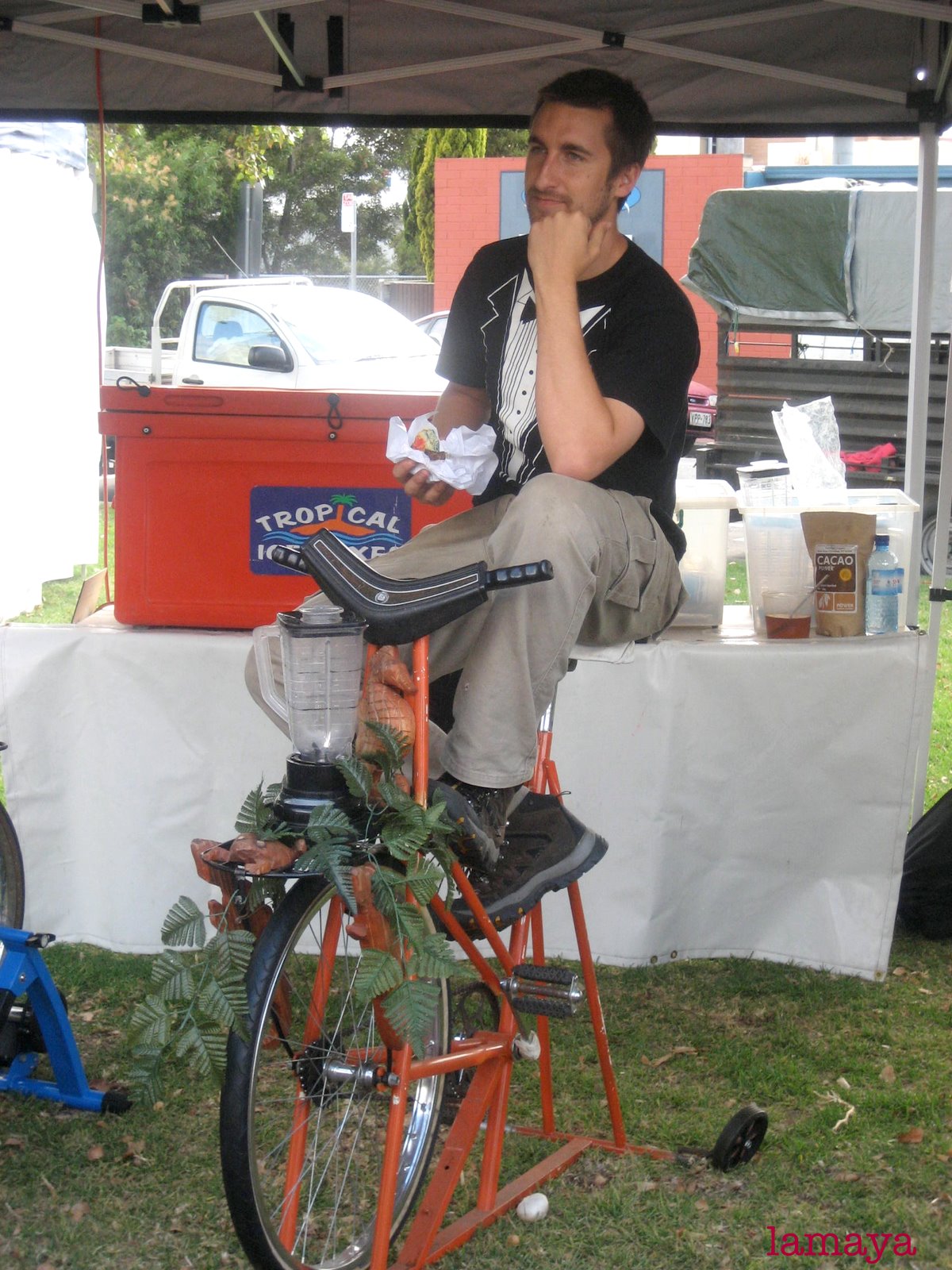
A Juicy Peddler

 This week's PhotoHunt theme is juicy.
On a Saturday morning at the Victor Harbor Market this peddler will spin your choice of ingredients into a juicy beverage.

Friday, November 19, 2010

A Cruise With Temptation

It is not uncommon to see dolphins swimming in the waters around Glenelg. On a cool fall morning last year I headed out on Temptation Cruises hoping to get a closer view of the magnificent animal. I am not much of a water lover, so I skipped the opportunity to swim with the dolphins, though there were a couple of brave souls that took to the waters. The cruise was a success and in the 3.5 hours that I was aboard the 58ft catamaran I saw over a dozen different dolphins

Most of our sighting were of bottlenose dolphins. Some of the mammals were on their own and others were in pods. The color of the bottlenose dolphin varies considerably, but generally this type of dolphin is light to slate grey. In our waters these animals can grow up to 2.8 meters long and weigh as much as 270 kilograms. The South Australian bottlenose dolphin’s diet primarily consist of fish and squid. They eat approximately 8 kilogram each day. They generally hunt individually, but when a food source is found pods will work together. I am glad that I did not resist Temptation, a memory that will last a lifetime.

Wednesday, November 17, 2010

Mt Crawford

A couple of weeks ago our hopes of spending the day on the trail were washed out by torrential spring time rains. Instead, we decided to spend the day driving the back country roads, exploring the Adelaide Hills area. To our surprise, less than an hour from town we came across Mount Crawford Forest Reserve, a wooded area that offered a variety of hiking trails and several camping areas. We decided that, weather cooperating, we would return the following weekend to camp and do some additional exploring.
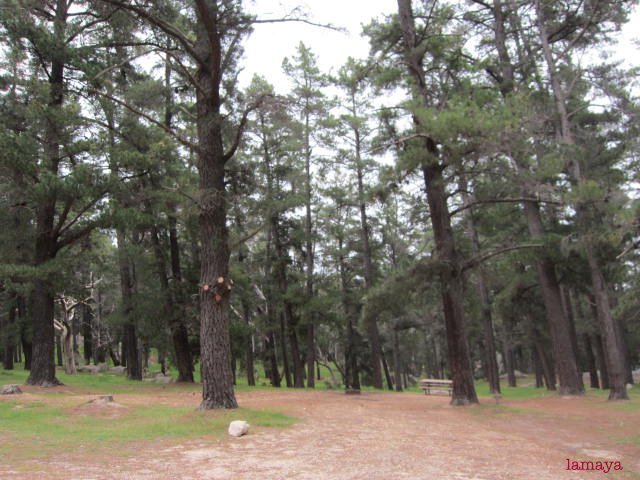
Mother Nature was on our side and the following weekend we headed for the hills. We decided to try our luck at Rocky Paddock, a fairly large campground nestled amongst an old pine plantation. When we arrived there were a couple of other campers nestled amongst the rocky outcrops. We headed to one of the more secluded edges and pitched our tent. We could only hope that no one would come along while we were out on the trail and set up camp right next to us. Once we had our territory staked out we hit the trail. 
The land, which was bought in 1909, has been used as eucalyptus and pine plantations since 1914. Currently 70,000 tons of timber is harvested annually from the area.  A variety of trails and tracks allow visitors to meander through a varied of landscape of eucalyptus, pine and native bush. Of course, since the trails traverse plantations, the tree groves are in different stages of the logging process. During our 5 hour loop we were treated to a walk amongst baby pine trees and some lumbering giants, as well as offered an opportunity to first handedly observe the destructive nature of the logging industry. The highlight of the day was our climb of Little Mount Crawford, where the land around the 525 meter peak has been left in its native state.
Mount Crawford Reserve is the perfect place for a day-trip or an overnighter. In addition to three camping areas that offer basic facilities there are numerous picnicking areas. However, visitors need to be aware that camping is only permitted from April through November, and there are strict fire restrictions. For more information about the area visit http://www.forestry.sa.gov.au/crawford.stm.