Wednesday, July 14, 2010

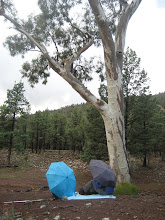
Camping In Litchfield National Park

We were a bit worried about finding a camping spot at Litchfield National Park.  It had taken longer than expected to pick up supplies in Darwin and we would arrive at the park just as the sun would start to set.  As we approached Mt. Bachelor and its commercial campground, the last stop before the park, we had to make a decision.  We decided to keep moving.  If worse came to worse we could always backtrack to what looked like a typical caravan park.
In less than an hour we began the descent down a rough 4wd road to the more isolated campground at Florence Falls.  Our hearts dropped as we found the bush camp full.  The road made it impossible for caravans to drive in, so we imagined that the campgrounds on the sealed roads would be even worse.  Rather than carrying on to the fully developed campsite at Florence Falls we headed to the smaller one at  Buley Falls.  With fingers crossed we hoped that fewer facilities would mean fewer campers. Luck was on our side and we found two open spots--one next to the long drop and the other right at the campground entrance. Needless to say, we didn't spend the night next to the stinky loo.
The campground was typical for Australia with campsites right on top of each other.  We actually lucked out in that we only had neighbors on one side.  By the end of the night, even though we never met them, we knew more than we wanted about the two drunk girls camped next to us.  All the info we learned about them made it seem as if we were close friends, yet the several times we ran into the girls over the next few days they didn't even recognize us.
We quickly set up camp as the sky turned from yellow, to pink, to orange, a finally to dull grey.  We could hear the running water close by, but decided to save the exploring for morning since we were unsure about the crocodile situation.   As dusk turned to dark an eeriness settled around us. Perhaps it was my fear of crocodiles, or the crackle of the bush fires that smoldered just a few hundred meters away.  Whatever the cause there was no way that you were going to get me to sleep in the tent, and I soon retired to the back of the Toyota RAV4.   
As the first light peeked over the horizon, with coffee cups in hand, we headed down to the water pools.  It turns out that this part of the park is crocodile free and an extremely popular swimming area.  Fortunately, dawn was not a peak time to visit and we had the spot to ourselves.  As we sat next to the river, surrounded by pandanus palms and paperbark trees, with birds of prey circling overhead, I was once again reminded of why I have come to love Oz.  

As we returned to camp we were greeted by the dozen or so other campers slowly beginning to stir.  Not soon after the first cuppa was drunk and the big brekkie eaten, many of our neighbors began to break up camp.  We were faced with a decision--to leave camp set up and stay for another night or to pack it up.  We decided that even though the location was not ideal, we would stick it out for another night.  At the time it didn't seem like a big deal.  In fact, after seeing the croc free swimming holes in the daylight I was willing to sleep in the tent.  Also, we could take a short trail to the longer trail that we planned to hike.  This meant we wouldn't have to stress at the end of the day of finding a place to stay.  To top it all off we could have a riverside picnic that evening.  
Of course things didn't work out as planned.  The long distance trail was closed-- the land it traversed had yet to be declared croc free.  We ended up having to get in the car and drive to another section of the park to hike.  Unfortunately, we decided to leave our stuff at what was declared our base camp--a decision that would cost us a night in paradise...

Monday, July 12, 2010

Mother Nature's Bioreactor

Imagine a million, blindfolded, 11 year olds building a skyscraper that covers eight city blocks and measures 2 kilometers in height. A pretty horrific thought, but when accomplished by one of Mother Nature's creatures it becomes an amazing engineering feat.  
Visitors may be drawn to Litchfield National Park's waterholes, but they don't want to miss the area's magnificent termite mounds. We aren't talking about a few small ant piles, but rather a series of protective fortresses that are built with grains of earth that are cemented together with termite saliva. The park's landscape is covered with innumerable dirt structures that vary in size and shape. Visitors will see knee-high piles, football size cones, enormous buttresses, and towering monoliths. The distinct physical characteristic of each mound is determined by the species of termite that has constructed it. The largest of the mounds are built by the  cathedral termite and can measure up to 6 meters high. However, it is not the sheer size that is the most impressive feature of the mounds, but instead the fact that the atmosphere within the mound is maintained between 25 to 30 degrees celcius. This is accomplished through the use of evaporative moisture cooling systems, solar collection, and the use of thermal mass for heat retention. A monumental architectural feat for a soft-bodied, ant-like insect.
Wow, all of this without MIT degrees.  


Cathedral Termite Mound

A second species of termites found in the park are magnetic termites. Temperature is also a driving factor in the construction of their mounds. Rather than creating massive structures, the magnetic termites build an edifice that resembles an enormous, sculptural tombstone. However, it is not just the structure that is critical in the thermoregulation of the mound, but it also involves the careful alignment of the mound.  Hence all magnetic termite mounds are perfectly aligned, north to south. The structure and positioning of the mound allows the sun to warm a larger surface area during the cooler mornings, evenings and winter months, raising the internal temperature of the mound.  Then during the heat of the day, due to the mounds narrow profile, less surface area is exposed and less heat is absorbed.


Magnetic Termite Mounds


Profile Magnetic Termite Mound

Saturday, July 10, 2010

Feral and Free


This weeks PhotoHunt theme is free.

Between 1860 and 1907 an estimated 10,000 to 12,000 camels were imported into Australia, and used as draft, pack and riding animals by people pioneering Central Australia. The animals were perfect for traversing the arid and isolated interior.  Not only were they able to travel great distances across hot, dry, sandy deserts with little food and water, but they could carry and haul heavy loads. In the mid 1920's, when motor vehicles began operating in the central areas of Australia, most camels were set free.  
Today, it is not uncommon to come across one of the feral descendants of the original imported camels in the Australian Outback. In fact, it is the only place in the world you can see a one-humped camel in the wild.
Recently we took a wrong turn near Alice Springs and happened to come across this big guy.    

Tuesday, July 6, 2010

Cool Fire

For tens of thousands of years the Aboriginal people of Australia have had a cultural obligation to look after and clean up the country.  One of the ways in which they completed this duty was through the use of fire--a tool that when used properly would create minimal harm while bringing maximum benefits.
Today, the National Parks of the Northern Territory are starting to realize the value of this ancient Aboriginal knowledge and fire is being used as a management tool to reduce the amount of fuel loads and to create firebreaks.  It is through the use of traditional patch burning during the cooler weather that the land and important historical sites can be protected from large, destructive wildfires later in the season.  It is also important to note that since traditional burning has been reinstated there has been an increase in native fora and fauna.

Since our visit to the Top End was during the cooler months of the dry season we saw several controlled fire burns.  As we entered Litchfield Park we were required to drive through a prescribed burn.  As we drove down the narrow road, the flames leaping toward the car, I couldn't help but wonder if our car rental insurance included third-degree burns.  It was also a bit eerie to sit at our campsite and not only hear the faint crackle but to see the smoke rising from the smoldering fires in the near distance--a stone throw from where we were to sleep.  As we drove and walked through the charred and sometimes burning landscape, I had to force myself to remember that it was not destruction that I was witnessing, but rather a temporary scar that in the long run will protect and encourage life.

"This earth.  I never damage.  I look after.  Fire is nothing. just clean up.  When you burn. new grass coming up.  That means good animal soon.  might be goanna. possum.  wallaby.  Burn him off.  new grass coming up. new life all over."
Bill Neidjie-Bunitj Clan

Saturday, July 3, 2010

No View Blocker Here


This week's PhotoHunter theme is open.

There are a lot of wide open spaces here in Australia.  This photo is of the Nullarbor Plain, the world's largest limestone karst landscape that occupies an area of about 200,000 square kilometers in the southwestern part of the continent.  The name Nullarbor derives from Latin and means no (nullus) trees (arbor).  With only a few hardy, drought-resistant and salt tolerant shrubs to block the view the Nullarbor is the perfect example of a wide open space.

Friday, July 2, 2010

Salty vs' Fresh

Prior to visiting the Top End of northern Australia I didn't know a whole lot about crocodiles, except that the Land Down Under has some fierce ones--or at least that was the picture that had been painted in my mind.  So as we sped past the first Crocodile Safety sign at the side of the road in Litchfield National Park, I quickly pulled out the guide book to learn more about the reptile whose habitat I was about to enter.  It turns out that there are more than 20 types of crocodilians in the world, and two species are found in Australia: the freshwater and the estuarine or saltwater crocodile.


Freshwater crocodiles are only found in Australia.  "Freshies" live in freshwater rivers, creeks and plunge pools.  They are relatively small and rarely grow to more than 2.5 meters in length and weigh no more than 60 kilos.  The nocturnal predator, enjoys a diet of birds, bats, reptiles, insects, fish, and small mammals. They are considered to be a timid animal, though they can become aggressive and bite if they are disturbed.  Fortunately, their jaws are not large or powerful enough to cause serious injury to humans.
Estuarine crocodiles are found in Australia, South East Asia, New Guinea and Indonesia.  Saltwater crocodiles live in estuaries and the sea, but during the wet season they can move into freshwater swamps and rivers .  "Salties" are the world's largest living reptile and the males average a length of five meters and weigh about 450 kilos.   Their diets are similar to their freshwater cousins, however they may also eat snakes, turtles, and larger mammals (including water buffalos and humans).  It is important to note that less than 30 people have been killed by crocodiles since 1971, but they are still an opportunistic predator that will quickly strike without warning.


Today there is an estimated population of 100,00 crocodiles in Australia.  However, from the 1940's thru the 1960's the reptile was hunted, for its skin, to near extinction.  They are now a protected species and it is illegal to injure or harm them.
As the estuarine crocodile population grows, they continue to move further inland into freshwater rivers, billabongs and creeks in search of new territory.  Thus, the National Parks of the Top End have had to implement crocodile management zones.  These zones are only open during the dry season, and are accessible after the areas have been extensively surveyed and any "salties" that have moved in during the wet season have been removed.  Traps remain in place for the entire dry season as a saltwater crocodile may move in at any time.  So when visiting the Parks of the Northern Territory it it critical that all warnings and closures be followed.

Thursday, July 1, 2010

Chocolate Covered Poached Pear

One of my favorite summer treats is chocolate covered strawberries.  Unfortunately, currently I am in the middle of winter so I decided to try dipping a more seasonally appropriate fruit in chocolate.  I first poached the pear so that it would be soft.  Also, I used milk chocolate since that is what I had on hand, but would use dark chocolate in the future.  I served the chocolate dipped pear on a blackberry/rhubarb compote.


INGREDIENTS

Pear
1 cup caster sugar
1/2 bottle white wine
4 cups water
1 cinnamon quill
1 star anise
4 small ripe pears
100 grams dark chocolate, chopped

Compote

2 sticks  rhubarb, cut into 1-2 cm pieces
3 tablespoons caster sugar
1/8 cup water
75 grams fresh or thawed frozen blackberries
1/2 tablespoon corn starch mixed with 1/2 teaspoon water


METHOD


For Pears
1. Combine sugar, wine, water, cinnamon, and star anise in a sauce pan over low heat.  Stir to dissolve sugar.  Add pears and cook until pears are tender (about 45 minutes.)  Chill pears in refrigerator.
2. Melt chocolate in a heatproof bowl over a saucepan of simmering water.  Remove pears from refrigerator and dry with a paper towel.  Dip bottom half of pear in chocolate.  A pastry brush can be used to spread the chocolate up the side of the pear.  Place chocolate dipped pear on wax paper and allow to set.

For Compote
1.  Place rhubarb in a saucepan with caster sugar and 1/8 cup water. Cover and place over medium heat and cook for 5-10 minutes until softened. Add blackberries and cook, uncovered, for 5 minutes until softened. Add the corn starch mixture and stir for 3-4 minutes until thickened. Set aside in a bowl to cool to room temperature for at least 5 minutes.