Wednesday, October 7, 2009

Dry


It is not uncommon to hear people in Adelaide claim that they live in the driest city, in the driest state, in the driest continent on Earth.  There have been drought conditions in this part of the world for the last several years.  Often, when I walk the streets of my new hometown I reflect on this fact.  As I look around me and see all the beautiful gardens and flowering trees, I find it hard to believe that there is a lack of water. Not only is there a lushness around me, but my skin feels hydrated, and I lack the constant thirst I have when I am in more arid country.
Throughout the winter we seemed to have plenty of days of rain.  Far more than I ever saw when living in Southern Spain, or back in Albuquerque.  Of course, the picture during the summer is different, and we can go several months without a single shower.  During this time the plants turn brown from a lack of water and the extreme heat.  However, during the dry season I still do not feel the effects of an extreme drought.
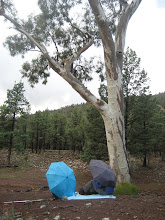
It was on a recent trip we took to Arkaroola Wilderness Sanctuary, an old sheep farm that has been returned to it's natural state, that that I was truly able to see the results of almost a decade of below normal precipitation. As we exited the car, I felt the moisture leave my skin and my lips crack. I immediately reached for my water bottle.  The spectacular scenery around us was dulled by the oppressive effects of the drought.  We did not expect this bleakness--after all South Australia has had the wettest winter in several years and just 250 km away we had crossed water filled gullies. I guess the waters had somehow failed to fall on this part of the northern Flinders Ranges.
We spent two days exploring the Arkaroola's peaks and gorges.  Once we got over the barrenness, we found the color and the rugged peaks of the land captivating. However, the devastation of the drought was ever present as we walked though the lifeless landscape that lacked waterholes and wildlife.  Apart from a flock of cockatoo's, 2 echidnas, and a lone 'roo at sunrise, we saw no other live animals while out on the trails, though there were plenty of sun dried carcasses--wallabies, kangaroos, and eagles.
The hardest part of the whole situation was man's lack of sensitivity to the dire situation of Arkaroola.  While walking back tracks we passed camp sites where smoldering fires had been left unattended while the campers were off 4 wheel driving.  We are very sensitive to this issue since one of the worst forest fires in New Mexico was caused by two tourists who left a smoldering campfire on a windy day.  Then, there were the women in the campground who took the never ending showers.  There were signs throughout the bathhouse reminding visitors of the lack of water, and asking us to minimize our use.  Several times I found myself turning off dripping faucets and blazing lights.  I can't help but wonder,  if people would get out of their 4 wheel drives and walk the land, they would realize just how catastrophic the drought is. Perhaps then they would realize that we need to do all we can to lessen the human impact on an uncontrollable situation.

Tuesday, October 6, 2009

The Last Stop


Monday was Labor Day here in Southern Australia.  It was not a National Holiday, and it occurs on different dates throughout the different States.  We decided to take advantage of the long weekend, and visit the Northern Flinders Ranges.
I have to laugh when I think back to a year ago, when I would never have imagined making the 1,200+ kilometer round trip journey: many dirt roads--into the remote wilderness mountains of Southern Australia.   Stories of the demise of ill-fated travelers, to the thought of the vast and harsh interior of the country, filled me with fear.  Over time I realized this fear was irrational.  Even though the land around me was wild and untamed, it was a threat only to those who do not respect it and who are not prepared.
We have made several different trips into the isolated bush.  Each trek has taken extensive planning and preparation.   For the most part our adventures have run smoothly.  However, on this last trip we were reminded that it is not enough to plan and prepare well; you have to expect the unexpected.
We planned to camp two nights at the Arkaroola Wilderness Sanctuary, which includes a village with varied accommodations: a restaurant, a store, and a garage.  We were completely self-sufficient and only needed to buy petrol and ice at the store.  We figured that by buying ice at the final destination, it would last longer.  We never even considered that the ice-machine at Arkaroola would be broken.  The next closest town was 167 kilometers away.  Fortunately, we only had a couple of items that needed to be on ice and all we had to do was change the order in which we ate pre-planned meals.  I will admit that bratwurst for breakfast with hot mustard is probably not my favorite, and that after 6 hours of hiking Mark was a little disappointed by the breakfast burrito (we had planned on a thick steak).  We survived the warm beer, and only had to throw away a few items.
Overall, we felt we were lucky.  It could have been worse. I could have had a week's worth of food that required refrigeration or the petrol pump could have been broken.  We also learned an important lesson-- in a land of extremes, and vast distances, don't wait for the last stop.

Monday, October 5, 2009

Yank


On my 7 a.m. bottle drops (see I Can't Stop Chasing Men) I was recently asked if I was from Canada.  When I replied, "No, I am from the United States," the bottle collector took a brief pause and then asked hesitantly "Are you a Yank?"  I had to chuckle, and said "Yes, I am a Yank."  My "friend" looked a bit confused and he then told me that he met another woman from the United States who got mad at him for calling her a Yank, and wanted to know why.  After all, when he was in the war the Americans all called themselves Yanks, and they even sang Yankee Doodle.  I was then treated to an Australian rendition of this American themed song.
I couldn't really answer his question.  I have heard many people from the US call themselves Yanks, but also know of many who are offended by the term.
I myself take the expression with tongue-in-cheek.  I don't really find it insulting, but instead look at it as a part of the Australian culture of  Ozspeak.  
Perhaps this an easy cultural border for me to cross; after all it is very common for New Mexicans to refer to people with nicknames--Cissy, Pancho, Chuy, Lupe, or Lalo.  There are also those names used to refer to people behind their back--La Falsy, Patito, Cry Baby, Big Boy, and SLT (Sabe Lo Todo).  The use of these names could be seen as derogatory in nature by some, but for many New Mexicans it is a cultural norm. 
I also know that Mark has no problem referring to himself as a Yank.  Even though he is not originally from New Mexico he is also familiar with the use of nicknames for humorous effect, and he went to college with Mango, Muscle Head, Crisco, and Uncle Animal.  
On the other hand, I know that I took offense to being called a Janqui in Spain.  I had no problem when called a guiri, though I identified myself as a New Mexican.  Maybe this was because I wanted to distance myself from the local US Air-force base--many of the service men, women and their families did not integrate into the local community.  Or perhaps it was my need to show my New Mexican-ness and the fact even though I  learned Spanish as an adult, I have historical ancestral ties to the language.  
As far as the present is concerned, I doubt that you will find me walking down the street singing Yankee Doodle, but I will not take offense at being called Yank.  However, I am insulted by Sepo--another term used for people from the United States.  It comes from an Australian tradition of playing with words.  Since tank rhymes with Yank, they take the term Septic Tank and reduce it to Sepo which comes to stand for Yank.  I do find this term to be a bit beyond tongue-in-check, and can not find any endearing qualities in it. 

Sunday, October 4, 2009

Marvelous Murray's Kiwi Fruit Tart

During the winter months there are always Kiwis in our house--the fruit not the bird!  I have found that the Kiwis here in Australia, are even tastier than those I have previously eaten.  I decided to take advantage of the end of the season and make one of our favorite tarts.  The following simple recipe comes from Epicurious.  I cut the Kiwis in rounds rather than quarters.

Marvelous Murray's Kiwi Fruit Tart


Sweet Pastry Dough


Ingredients 
2 sticks (1 cup) cold unsalted butter
2 2/3 cups all-purpose flour
1/4 cup sugar
1/2 teaspoon salt
2 large egg yolks
3 tablespoons ice water

Preparation

Cut butter into bits. In a bowl with a pastry blender or in a food processor blend or pulse together flour, sugar, salt, and butter until mixture resembles coarse meal. In a small bowl whisk together yolks and ice water. Add yolk mixture to flour mixture and toss or pulse until incorporated. Form dough into a ball and wrap in plastic wrap. Chill dough 1 hour.


Tart

Ingredients
rice for weighting shell
1 cup hazelnuts (about 1/4 pound)
8 kiwifruits
1/2 vanilla bean
3/4 stick (6 tablespoons) unsalted butter
1/4 cup all-purpose flour
2 large eggs
1/2 cup sugar
1 tablespoon dark rum


Preparation 

Reserve a quarter of dough for another use. On a floured surface with a floured rolling pin roll out remaining dough into a 14-inch round (about 1/8 inch thick) and fit into an 11- by 1 1/4-inch round tart pan with a removable fluted rim. Trim dough flush with rim. (Don't worry if dough cracks; press dough together to patch any holes.) Prick shell lightly all over with a fork. Chill shell, covered, 30 minutes. Preheat oven to 425°F. Line shell with foil and fill with pie weights or raw rice. Bake shell in middle of oven 15 minutes and remove weights or rice. Bake shell until pale golden, about 10 minutes more, and transfer to a rack to cool. Reduce temperature to 350°F. Chop hazelnuts. Peel kiwifruits and quarter lengthwise. Halve vanilla bean half lengthwise and scrape seeds into a small saucepan, reserving pod for another use. Add butter and melt over moderately low heat until golden brown. Cool mixture to room temperature. Into a small bowl sift flour. In a bowl with an electric mixer beat eggs with sugar and rum until thick and pale. Fold in flour gently but thoroughly. Fold butter into egg mixture gently but thoroughly. Arrange kiwifruits evenly in one layer in tart shell and pour filling over them, spreading evenly. Sprinkle hazelnuts over filling and bake in middle of oven 35 minutes, or until top is golden. Cool tart in pan on a rack.

Saturday, October 3, 2009

Words


This week's theme is words.


When you head into the Australian Outback, it doesn't take long for the voice on the radio to fade and for mobile signals to disappear.  Unless you have a UHF radio you become cut off from the rest of the world.  The words on the signs become your friends and provide you with all the important information you need for a successful trip.

Friday, October 2, 2009

Moons of Australia


Full Moons in Australia
The moon has been a re-occuring theme in our lives since our arrival in Australia.
We have been accompanied by a full moon on many of our trips.  At Uluru we witnessed a simultaneous reflecting sunset and full moon rise at one of Australia's most famous icons.  In Tasmania we were able to take a moonlit boardwalk hike at Cradle Mountain. At the Pinnacles, in Western Australia, we saw the full moon set as the sun rose.  In Sydney the round circle in the sky contrasted with the geometric shapes of the Opera house.  At the Flinders Range the full moon was our only company at the deserted Wilkawillina Campground.
In July our attention was drawn to the moon as we celebrated 40 years since the first moon walk.  The actual date of this historical event depends on where you live.  In Australia it was the 21st of of July, whereas in the United States it was on the 20th of July--because of the time zones.  A few weeks prior to the 4 decade anniversary we just happened to rent the Australian film "The Dish".  The story, which takes place in New South Whales, describes of the role that the Parkes Observatory  played in the broadcasting of man's first steps on the moon in 1969.  Prior to viewing the movie I had no idea that Australia played such an important role in the bringing  of Neil Armstrong's "One small step for man, one giant leap for mankind." down to earth.  Perhaps part of my ignorance is due to the fact that back in 1969 I was only one year old.  My Mom, however, did save a newspaper clipping for posterity's sake. I doubt that I am the only one that did not know this important fact.
The same week as the anniversary of the Lunar Landing, we visited the Moon Plain--a section of desert  that has been named because of it's lunar-like surface.  The Moon Plain is located 15 km north east of Coober Pedy, and is probably best known as the backdrop for Mad Max Beyond Thunder Drome.  It is unlike any other place that I have visited.  As you stand on the crunchy, "spider" cracked surface, gazing across the barren landscape, it is not hard to imagine that you are standing on the moon.


The Moon Plain
Finally, though not directly related to the moon, last June we grieved to loss of the world's most famous Moonwalker, Michael Jackson.

Thursday, October 1, 2009

Kan see 'roo


This weekend marks the year anniversary of my first wild 'roo sighting.  I remember the event clear as day.  We were cruising down the Southern Expressway, when in my peripheral vision, I caught a glimpse of a kangaroo's ears bouncing above the barrier wall.  No wait, that was the ponytail of the runner with a serious spring in her step.  Oh, I remember...it was further down the road.  On the hillside in the distance, there it was hunched over--enjoying some nibblies.  No, that was a granite boulder in a field.  Ahhh, now I know.  It was that crazed blob bouncing from one side of the road to the other--unable to escape because of the high chain link fence.  That was it!!  Between my shrieking, "It's a roo, it's a roo!!," and the animal flying all over the road, it's a miracle Mark didn't wreck the car.  It was such an emotional moment that I almost pissed myself.
Since then, there have been hundreds if not thousands of 'roo views.  Mark calls me the kangaroo detector, and I can spot even the best camouflaged animal.  However, when Mom came for a visit I was very stressed that perhaps my new found ability would falter, and that I wouldn't be able to share a wild experience with her.
As I planned our "let's show Mum Australia" itinerary, I remembered that at one of the Expat in Adelaide meetings I was talking to Brett, who told me that if you wanted to be sure to see a 'roo to head down to Deep Creek Conservation Park on the Fleurieu Peninsula.  I decided to take a gamble, and take his word for it.  It turns out that Brett is not a lying man.  When we arrived at Deep Creek Conservation Park, an hour and a half south of Adelaide, we were treated to mobs of Western Grey Kangaroos.
There were plenty of these normally nocturnal animals lounging around or having a mid-morning snack.   The Western Grey Kangaroo, whose fur color ranges from grey to brown, loves the lifestyle of Southern living, and can be found in the scrublands and forests of Southern Australia.


At DCCP we saw fliers with their joeys.  We  observed some of the little joeys use their powerful hind legs to quickly hop and dive back into their mother's pouch when we came near.  Many of the moms would just rise on their hind legs, using their strong tails as support, and observe us.  There were also some boomers around.  At over 4 feet in height some of the bigger guys were almost taller than my mom, and I am glad that none of them tried to engage her in a boxing match.


As we left the Conservation Park, I was pleased that I was able to share the joy of seeing a Kangaroo in the wild with my mother.  I felt that it was the perfect Mother's Day gift.